Advertisements
Advertisements
Question
Given below is an experimental setup to demonstrate a particular tropic movement in germinating seeds. Study the diagram and answer the questions that follow:
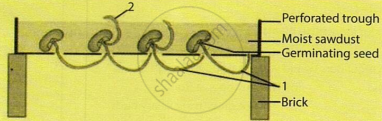
- Label the parts 1 and 2.
- Name the tropic movement shown by part 1.
- Part 1 is affected by two stimuli. Name them. Which one of the two is stronger?
- What is thigmotropism? Give one example.
- What is meant by 'Positive' and 'Negative' tropic movements in plants?
Advertisements
Solution
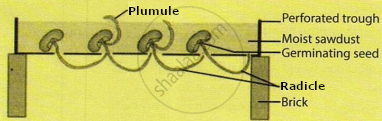
- The tropic movement shown in part 1 is Hydrotropism.
- Part 1 is affected by gravity and water(moisture); water is stronger.
- The growth movement of plant parts in response to a touch stimulus is called Thigmotropism. Example: Plants such as Sweet Peas, Cuscuta and vines have tendrils that coil around other plants or other available support in response to one-sided contact or touch.
- Directional movement of a plant part towards the stimulus is called positive tropic movement, and away from the stimulus is called negative tropic movement.
APPEARS IN
RELATED QUESTIONS
Name the following:
The products that are formed as a result of photosynthesis.
Complete the following by filling in the blanks numbered 1 to 10 with the appropriate word/term:
Photosynthesis involves light reaction and dark reaction. During light reaction, the chlorophyll present in the (1) ______ gets activated by absorbing light energy. This energy splits (2) ______ molecules to (3) ______ and oxygen and releases two electrons. This process is called (4) ______. The (5) ______ ions are picked up by NADP to form (6) ______. The ADP is converted to (7) ______. This process is called (8) ______. During the dark phase, the compound produced at the end of the light reaction reacts with carbon dioxide to form (9) ______. This product is converted to starch. The process is called (10) ______.
The diagram alongside represents an experiment conducted to prove the importance of a factor in photosynthesis.
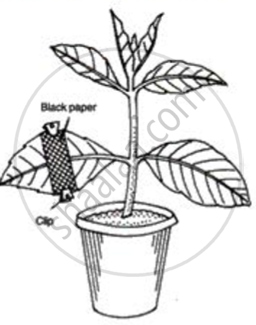
Study the same and then answer the questions that follow:
(i) Name the factor being studied in his experiment.
(ii) Why was the plant kept in a dark room before conducting the experiment?
(iii}Why was the experimental leaf then kept in
1. boiling water 2. methylated spirit?
(iv) Name the solution used to test for the presence of starch in the leaf.
(v) What will we observe in the experimental leaf at the end of the starch test?
(vi) Give a balanced chemical equation to represent the process of photosynthesis.
Are the following statement true or false? Give a reason in support of your answer.
The rate of photosynthesis continues to rise as long as the intensity of light rises.
Are the following statement true or false? Give a reason in support of your answer.
Photosynthesis is considered as a process supporting all life on earth.
The figure given below is for performing an experiment on photosynthesis.

Answer the following:
(i) What is the aim of this experiment?
(ii) Describe an experiment to show that light is necessary for photosynthesis.
(iii) What do you conclude from this experiment?
(iv) What is the role of light in photosynthesis?
Complete the following sentence with appropriate word:
A dark reaction is a __________ reaction.
Complete the following sentence with appropriate word:
4OH ——> _____ + O2
Oxygen is produced at what point during photosynthesis?
