Advertisements
Advertisements
प्रश्न
Given below is an experimental setup to demonstrate a particular tropic movement in germinating seeds. Study the diagram and answer the questions that follow:
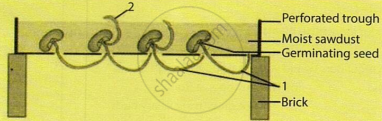
- Label the parts 1 and 2.
- Name the tropic movement shown by part 1.
- Part 1 is affected by two stimuli. Name them. Which one of the two is stronger?
- What is thigmotropism? Give one example.
- What is meant by 'Positive' and 'Negative' tropic movements in plants?
Advertisements
उत्तर
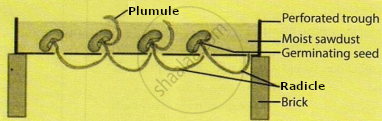
- The tropic movement shown in part 1 is Hydrotropism.
- Part 1 is affected by gravity and water(moisture); water is stronger.
- The growth movement of plant parts in response to a touch stimulus is called Thigmotropism. Example: Plants such as Sweet Peas, Cuscuta and vines have tendrils that coil around other plants or other available support in response to one-sided contact or touch.
- Directional movement of a plant part towards the stimulus is called positive tropic movement, and away from the stimulus is called negative tropic movement.
APPEARS IN
संबंधित प्रश्न
Give biological reasons for the following statements : In some xerophytes leaves are modified into spines
Given below is an experiment setup to demonstrate a particualr tropic movement in germinating seeds. Study the diagram and answer the questions that follow : 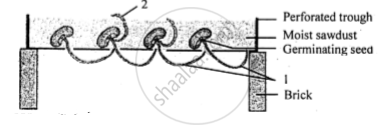
What is meant by ‘Positive’ and ‘Negative’ tropic movements in plants?
The diagram given below represents an experiment to prove the importance of a factor in photosynthesis. Answer the questions that follow :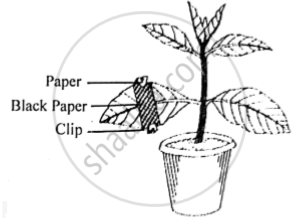
Explain the process of Photosynthesis.
State the main functions of the following:
Cytokinins
The following statement is about photosynthesis in a green plant. Write whether it is True or False.
Photosynthesis occurs in all the cells of the plant.
Choose the correct answer:
Which of the following gas is used in photosynthesis?
Give technical term:
What is the percentage of CO2 in the air?
Mention, if the following statement is True or False. If false rewrite the wrong statement in its correct form:
A variegated leaf (one that has green as well as white patches) will only photosynthesize in the green areas.
Mention, if the following statement is True or False. If false rewrite the wrong statement in its correct form:
Photosynthesis can also occur n artificial light such as that of a 100-watt electric lamp.
A plant is kept in a dark room for about 24 hours before conducting any experiment on photosynthesis in order to ______.
