Advertisements
Advertisements
प्रश्न
Given below is an experimental setup to demonstrate a particular tropic movement in germinating seeds. Study the diagram and answer the questions that follow:
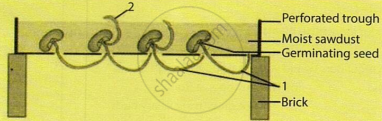
- Label the parts 1 and 2.
- Name the tropic movement shown by part 1.
- Part 1 is affected by two stimuli. Name them. Which one of the two is stronger?
- What is thigmotropism? Give one example.
- What is meant by 'Positive' and 'Negative' tropic movements in plants?
Advertisements
उत्तर
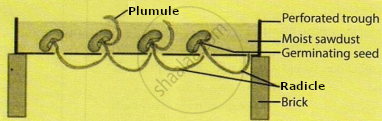
- The tropic movement shown in part 1 is Hydrotropism.
- Part 1 is affected by gravity and water(moisture); water is stronger.
- The growth movement of plant parts in response to a touch stimulus is called Thigmotropism. Example: Plants such as Sweet Peas, Cuscuta and vines have tendrils that coil around other plants or other available support in response to one-sided contact or touch.
- Directional movement of a plant part towards the stimulus is called positive tropic movement, and away from the stimulus is called negative tropic movement.
APPEARS IN
संबंधित प्रश्न
Fig. demonstrates a physiological process taking place in green plants. The whole set-up was placed in bright sunlight for several hours. Study the diagram and answer the questions that follow:
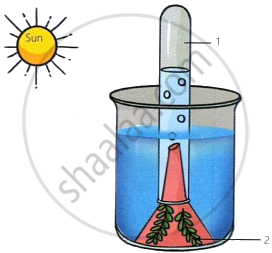
- What aspect of the physiological process is being examined?
- Explain the physiological process mentioned in (a) above.
- Label the parts numbered 1 and 2 in the diagram.
- Write a well-balanced chemical equation for the physiological process explained in (b) above.
- What would happen to the rate of bubbling of the gas if a pinch of sodium bicarbonate is added to the water in the beaker? Explain your answer.
The diagram below shows two test-tubes A and B. Test-tube A contains a green water plant. Test-tube B contains both a green water plant and a snail. Both testtubes are kept in sunlight. Answer the questions that follow:

(i) Name the physiological process that releases the bubbles of oxygen.
(ii) Explain the physiological process as mentioned above in Q2 (a)(i).
(iii) What is the purpose of keeping a snail in test-tube ‘B’?
(iv) Why does test-tube ‘B’ have more bubbles of oxygen?
(v) Given an example of a water plant that can be used in the above process.
(vi) Write the overall chemical equation for the above process.
Complete the following by filling in the blanks numbered 1 to 10 with the appropriate word/term:
Photosynthesis involves light reaction and dark reaction. During light reaction, the chlorophyll present in the (1) ______ gets activated by absorbing light energy. This energy splits (2) ______ molecules to (3) ______ and oxygen and releases two electrons. This process is called (4) ______. The (5) ______ ions are picked up by NADP to form (6) ______. The ADP is converted to (7) ______. This process is called (8) ______. During the dark phase, the compound produced at the end of the light reaction reacts with carbon dioxide to form (9) ______. This product is converted to starch. The process is called (10) ______.
Explain the Term Free Energy.
Explain the term Phosphorylation.
Give technical term:
What does ATP abbreviate for?
Give technical term:
What does NADP stand for?
Autotrophs use _____,______ and chlorophyll to prepare their own food.
What are primary producers?
Plants utilize only ______% of the absorbed water for photosynthesis and the other activities.
