Advertisements
Advertisements
Question
Complete the following by filling in the blanks numbered 1 to 10 with the appropriate word/term:
Photosynthesis involves light reaction and dark reaction. During light reaction, the chlorophyll present in the (1) ______ gets activated by absorbing light energy. This energy splits (2) ______ molecules to (3) ______ and oxygen and releases two electrons. This process is called (4) ______. The (5) ______ ions are picked up by NADP to form (6) ______. The ADP is converted to (7) ______. This process is called (8) ______. During the dark phase, the compound produced at the end of the light reaction reacts with carbon dioxide to form (9) ______. This product is converted to starch. The process is called (10) ______.
Advertisements
Solution
Photosynthesis involves light reaction and dark reaction. During light reaction, the chlorophyll present in the leaves gets activated by absorbing light energy. This energy splits water molecules to hydrogen ion and oxygen and releases two electrons. This process is called photolysis. The hydrogen ions are picked up by NADP to form NADPH2. The ADP is converted to ATP. This process is called photophosphorylation. During the dark phase, the compound produced at the end of the light reaction reacts with carbon dioxide to form glucose. This product is converted to starch. The process is called polymerization.
APPEARS IN
RELATED QUESTIONS
the exact location of the Thylakoids
The following statement is about photosynthesis in a green plant. Write whether it is True or False.
The raw materials for photosynthesis include water and carbon dioxide.
If the rate of respiration becomes more than the rate of photosynthesis, plants will:
Photosynthesis in green plants is directly and indirectly dependent on so many plant structures.
Explain briefly the role of the following structures in this process is Stomata.
Explain the Term Calvin Cycle.
State whether true or false. If false, correct the statement.
When the weather is hot, water evaporates lesser which is due to opening of stomata.
Name the plant part
- Which bends in the direction of gravity but away from the light.
- Which bends towards light but away from the force of gravity.
Study the pictures below and then complete the table by putting a plus (+) if the shoot or root grows towards the stimulus and a minus (-) if it grows away from it.
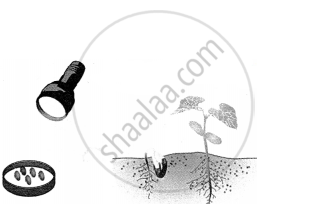
| Stimulus | Light | Gravity |
| Shoot | + | - |
| Root | ? | + |
Draw the structure of the stomata and label the parts.
