Advertisements
Online Mock Tests
Chapters
1: Cell Division
2: Structure of Chromosomes
3: Principles of Genetics
Unit-2 Plant Physiology
4: Absorption by Roots
5: Transpiration
6: Photosynthesis
7: Chemical Coordination in Plants
8: Circulatory System
Unit-3 Human Anatomy and Physiology
9: Excretory System
10: Nervous System
11: Endocrine System
12: Reproductive System
13: Human Population
14: The Evolution of Man
15: Theories of Evolution
▶ 16: Types of Pollution
17: Sources of Pollution and Major Pollutants
18: Effects of Pollution
19: Abatement of Pollution
20: Greenhouse Effects, Global Warming, Ozone Layer Depletion and Acid Rain
![Frank solutions for Biology Part 2 [English] Class 10 ICSE chapter 16 - Types of Pollution - Shaalaa.com](/images/biology-part-2-english-class-10-icse_6:4cd9978ddb1c4f42b0b0e9ec6f09c057.jpg "Frank solutions for Biology Part 2 [English] Class 10 ICSE chapter 16 - Types of Pollution")
Advertisements
Solutions for Chapter 16: Types of Pollution
Below listed, you can find solutions for Chapter 16 of CISCE Frank for Biology Part 2 [English] Class 10 ICSE.
Frank solutions for Biology Part 2 [English] Class 10 ICSE 16 Types of Pollution Excercise [Pages 215 - 216]
Choose the correct alternative from the choices given below each statement.
Which of these is the most dangerous pollution?
Air
Soil
Water
Radiation
Sound becomes hazardous noise pollution at decibels ______.
above 30
above 80
above 100
above 120
Taj Mahal at Agra may be damaged by ______.
sulphur dioxide
chlorine
hydrogen
oxygen
The atmosphere of big cities is polluted most by ______.
automobile exhausts
pesticides
household waste
radioactive fall out
Name the following.
Sound that becomes hazardous at higher decibels.
A combination of smoke and fog.
Name the following.
The emission of invisible radiations.
Name the following.
A non-biodegradable pollutant.
Name the following.
Four air pollutants.
Name the following.
Two examples of marine pollution.
An example of natural air pollution is ______.
Fill in the blanks:
Water is ______ for life.
Noise pollution can cause ______ and other disorders.
Smog is the combination of ______ and ______.
Increase in concentration of soluble salts in the soil is called ______.
Forest fires and volcanoes release a large amount of particulate matter and ______.
______ are the major contributors to air pollution.
______ are the major carriers of waste water that is off-loaded into the sea.
State whether the following statement is true or false: If false, re-write the correct form of the statement by changing the word/words.
Urbanisation with faster modes of transport have contributed to pollution.
State whether the following statement is true or false: If false, re-write the correct form of the statement by changing the word/words.
Any unwanted sound, even if it is music next door, is noise.
State whether the following statement is true or false: If false, re-write the correct form of the statement by changing the word/words.
People who are used to work in noisy places are not affected by noise.
State whether the following statement is true or false: If false, re-write the correct form of the statement by changing the word/words.
Underground water is non-polluted and safe.
State whether the following statement is true or false: If false, re-write the correct form of the statement by changing the word/words.
Pollutants are the substances that cause pollution.
Define the following term:
Pollution
Define smog.
Define the following term:
Air pollution
Define ‘Noise Pollution’.
Give the biological/technical term for the following:
A mixture of smoke and fog.
Give the biological/technical term for the following.
A constituent which causes pollution.
What is pollution?
What is the difference between pollutant and contaminant?
Distinguish between the following pair:
Smoke and smog.
What is the difference between air pollution and water pollution?
Name the following.
Four air pollutants.
List five water pollutants.
What is water pollution?
What is radiation pollution?
What are the two areas where development has resulted into pollution?
Name two suspended impurities present in fresh water.
Name two dissolved impurities present in fresh water.
Give two examples of man-made pollutants.
Give two examples of natural pollutants.
Give two examples of Radioactive pollutants.
What is the emission of invisible radiations called?
Discuss the impact of noise pollution.
‘Noise pollution has become a part of industrial and urbanized life in the modern times’. Justify.
Environmental pollution is a recent problem. Do you agree with this? Give reasons.
‘Noise is regarded as unwanted sound.’ Justify.
Give two examples of marine pollution.
What do you know about ocean water pollution?
What is water pollution?
Classify water pollutants.
State any two harmful effects of noise pollution on human health.
Give biological explanations for All the food chains begin with green plants.
Given below is a representation of a kind of pollution. Study the same and answer the questions that follow:
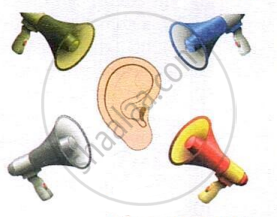
- Name the kind of pollution.
- List any three common sources of this pollution.
- Mention three pollutants.
Give two examples of water pollutants.
Solutions for 16: Types of Pollution
Frank solutions for Biology Part 2 [English] Class 10 ICSE chapter 16 - Types of Pollution
Shaalaa.com has the CISCE Mathematics Biology Part 2 [English] Class 10 ICSE CISCE solutions in a manner that help students grasp basic concepts better and faster. The detailed, step-by-step solutions will help you understand the concepts better and clarify any confusion. Frank solutions for Mathematics Biology Part 2 [English] Class 10 ICSE CISCE 16 (Types of Pollution) include all questions with answers and detailed explanations. This will clear students' doubts about questions and improve their application skills while preparing for board exams.
Further, we at Shaalaa.com provide such solutions so students can prepare for written exams. Frank textbook solutions can be a core help for self-study and provide excellent self-help guidance for students.
Concepts covered in Biology Part 2 [English] Class 10 ICSE chapter 16 Types of Pollution are Waste, Pollution, Soil Pollution, Sources of Soil Pollution, Radiation, Noise Pollution, Sources of Noise Pollution, Acid Rain, Greenhouse Effect and Global Warming, Ozone Layer Depletion, Effects on Human Health, Control of Pollution, Swachh Bharat Abhiyan (Clean India Movement), Plastic Pollution.
Using Frank Biology Part 2 [English] Class 10 ICSE solutions Types of Pollution exercise by students is an easy way to prepare for the exams, as they involve solutions arranged chapter-wise and also page-wise. The questions involved in Frank Solutions are essential questions that can be asked in the final exam. Maximum CISCE Biology Part 2 [English] Class 10 ICSE students prefer Frank Textbook Solutions to score more in exams.
Get the free view of Chapter 16, Types of Pollution Biology Part 2 [English] Class 10 ICSE additional questions for Mathematics Biology Part 2 [English] Class 10 ICSE CISCE, and you can use Shaalaa.com to keep it handy for your exam preparation.
