Advertisements
Online Mock Tests
Chapters
1: Cell Division
▶ 2: Structure of Chromosomes
3: Principles of Genetics
Unit-2 Plant Physiology
4: Absorption by Roots
5: Transpiration
6: Photosynthesis
7: Chemical Coordination in Plants
8: Circulatory System
Unit-3 Human Anatomy and Physiology
9: Excretory System
10: Nervous System
11: Endocrine System
12: Reproductive System
13: Human Population
14: The Evolution of Man
15: Theories of Evolution
16: Types of Pollution
17: Sources of Pollution and Major Pollutants
18: Effects of Pollution
19: Abatement of Pollution
20: Greenhouse Effects, Global Warming, Ozone Layer Depletion and Acid Rain
![Frank solutions for Biology Part 2 [English] Class 10 ICSE chapter 2 - Structure of Chromosomes - Shaalaa.com](/images/biology-part-2-english-class-10-icse_6:4cd9978ddb1c4f42b0b0e9ec6f09c057.jpg "Frank solutions for Biology Part 2 [English] Class 10 ICSE chapter 2 - Structure of Chromosomes")
Advertisements
Solutions for Chapter 2: Structure of Chromosomes
Below listed, you can find solutions for Chapter 2 of CISCE Frank for Biology Part 2 [English] Class 10 ICSE.
Frank solutions for Biology Part 2 [English] Class 10 ICSE 2 Structure of Chromosomes Exercises [Pages 20 - 23]
Choose the correct answer:
The network of fine threads in nucleus is called __________
chromosome
chromonemata
chromatid
chromatin
Choose the correct answer:
The term 'chromosome' was coined by ___________
Balbiani
Darwin
Waldeyer
Sutton and Boveri
A structure not present in all chromosomes is ______.
centromere
chromonemata
secondary constriction
telomere
Choose the correct answer:
Chromosomes are thin and thread like at __________
interphase
metaphase
anaphase
pachytene
Choose the correct answer:
Chromosomes largely consist of _______________
DNA and histones
DNA and RNA
RNA and histones
histones and ions
Chromosome number in humans is ______.
46
23
64
45
Telocentric chromosomes are ______.
Rod-shaped
V-shaped
J-shaped
L-shaped
A V-shaped chromosome is ______.
acrocentric
metacentric
telocentric
sub-metacentric
Choose the correct answer:
Sex chromosomes in man are _____________
XX
YY
XY
none of these
Choose the correct answer:
Sex of an individual is determined by ____________
autosomes
sex chromosomes
lampbrush
polytene chromosomes
The DNA double-helix model was given by ______.
Watson and Crick
Sutton and Boveri
Balbiani and Darwin
Waldeyer and Carlson
Choose the correct answer :
Adenine is a __________
nitrogen base
pentose sugar
fatty acid
enzyme
Choose the correct answer :
Which of these is not present in DNA?
Adenine
Thymine
Uracil
Cytosine
Choose the correct answer :
Spirally coiled double strands are observed in ____________
DNA
chromosome
RNA
chromatin
Duplicated chromosomes are joined at a point termed ______.
Centrosome
Centromere
Centriole
Chromatid
Assertion-Reason Type Questions Following questions consist of two statements - Assertion (A) and Reason (R). Answer these questions by selecting the appropriate option given below:
Assertion (A): Chromosomes are folds of chromatin fibres packed with DNA and proteins that form the genetic material.
Reason (R): Genes are segments of RNA and is the fundamental unit of heredity.
Both A and R are true and R is the correct explanation of A.
Both A and R are true but R is not the correct explanation of A.
A is true but R is false.
A is false but R is true.
Assertion (A): Every cell’s telomeres act as an ageing clock.
Reason (R): Telomeres are protective nucleotide sequences that are present at the ends of chromosome and they get shorter as cell divide.
Both A and R are true and R is the correct explanation of A.
Both A and R are true but R is not the correct explanation of A.
A is true but R is false.
A is false but R is true.
Assertion (A): Chromosomes are responsible for the transfer of characteristics from parents to offspring.
Reason (R): Chromosomes are present in the nucleus.
Both A and R are true and R is the correct explanation of A.
Both A and R are true but R is not the correct explanation of A.
A is true but R is false.
A is false but R is true.
Assertion (A): The spindle fibers play a crucial role in chromosome movement during cell division.
Reason (R): They attach to the centromeres and help separate sister chromatids.
Both A and R are true and R is the correct explanation of A.
Both A and R are true but R is not the correct explanation of A.
A is true but R is false.
A is false but R is true.
Name the following.
Transfer of genes from one organism to the other.
Name the following.
Thread-like structures in nucleus.
Name the following.
Hereditary material.
Name the following.
Number of chromosome in human beings.
Name the following.
Number of autosomes in human beings.
Name the following.
Chromosome that determines the sex of an individual.
Give an appropriate biological/technical term for the following:
A pair of corresponding chromosomes of the same size and shape, one from each parent.
Read the explanation given below and name the structure:
The point of attachment of two chromatids of a chromosome.
Fill in the blank:
DNA replicates in the ______ of the cell cycle.
Fill in the blank:
Chromatin fibre is made up of DNA and ______.
Fill in the blank:
DNA acts as director of ______ synthesis.
DNA strands are made up of phosphate groups, pentose sugar and four types of ______ bases.
State whether the following sentence is true or false:
Each spiral of the DNA has 12 nucleotides.
True
False
State whether the following sentence is true or false:
The two DNA chains are parallel to each other.
True
False
State whether the following sentence is true or false:
In any specimen of DNA, the total molar amount of A + G = T+ C.
True
False
Write a sentence of the following:
Sheath
Write a sentence of the following:
Matrix
Write a sentence of the following:
Chromonemata
Write a sentence of the following:
Centromere
Write a sentence of the following:
Secondary constriction
Write a sentence of the following:
Telomere
Mention the contribution of the scientist given below in the study of chromosome:
Strasburger
Mention the contribution of the scientist given below in the study of chromosome:
Balbiani
Mention the contribution of the scientist given below in the study of chromosome:
Waldeyer
Mention the contribution of the scientist given below in the study of chromosome:
Sutton and Boveri
Give one example:
A nitrogenous base in DNA.
What are the sex chromosomes in a human?
Give the chemical composition of chromosomes.
Draw a duplicate chromosome and label its part.
Name the following:
The number of chromosomes present in a nerve cell of a human being.
Correct the following statement by changing the underlined word:
Nitrogen bonds are present between the complementary nitrogenous bases of DNA.
Give an appropriate biological or technical term for the following:
The condition in which a pair of chromosomes carry similar alleles of a particular character.
Give appropriate biological or technical terms for the following :
The complex consisting of a DNA strand and a core of histones
Given below is a diagram of a double helical structure of DNA.
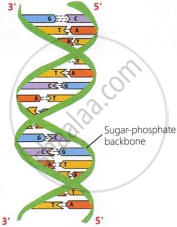
- Name the four nitrogenous bases that form a DNA molecule.
- Give the full form of DNA.
Mention the two rafts of nitrogenous bases which pair with each other with hydrogen bonds.
Solutions for 2: Structure of Chromosomes
Frank solutions for Biology Part 2 [English] Class 10 ICSE chapter 2 - Structure of Chromosomes
Shaalaa.com has the CISCE Mathematics Biology Part 2 [English] Class 10 ICSE CISCE solutions in a manner that help students grasp basic concepts better and faster. The detailed, step-by-step solutions will help you understand the concepts better and clarify any confusion. Frank solutions for Mathematics Biology Part 2 [English] Class 10 ICSE CISCE 2 (Structure of Chromosomes) include all questions with answers and detailed explanations. This will clear students' doubts about questions and improve their application skills while preparing for board exams.
Further, we at Shaalaa.com provide such solutions so students can prepare for written exams. Frank textbook solutions can be a core help for self-study and provide excellent self-help guidance for students.
Concepts covered in Biology Part 2 [English] Class 10 ICSE chapter 2 Structure of Chromosomes are Mitosis > Karyokinesis (Division of Nucleus), Need for New Cells, Cell Cycle - "Divide, Grow and Redivide", Meiosis: Reduction Division, Chromatin, Deoxyribonucleic Acid (DNA), Histone Proteins, Stages of Meiosis: Meiosis I, Stages of Meiosis: Meiosis II, Cell Division: an Essential Life Process, Mitosis > Karyokinesis (Division of Nucleus), Mitosis > Cytokinesis (Division of Cytoplasm), Genes and Genetic, Significance of Meiosis, Significance of Mitosis, Mitosis Vs Meiosis, Comparison of Mitosis in Plant and Animal Cells, Interphase, Mitochondria and Chloroplasts in Cell Division, Mitosis > Karyokinesis (Division of Nucleus), Need for New Cells, Cell Cycle - "Divide, Grow and Redivide", Meiosis: Reduction Division, Chromatin, Deoxyribonucleic Acid (DNA), Histone Proteins, Stages of Meiosis: Meiosis I, Stages of Meiosis: Meiosis II, Cell Division: an Essential Life Process, Mitosis > Karyokinesis (Division of Nucleus), Mitosis > Cytokinesis (Division of Cytoplasm), Genes and Genetic, Significance of Meiosis, Significance of Mitosis, Mitosis Vs Meiosis, Comparison of Mitosis in Plant and Animal Cells, Interphase, Mitochondria and Chloroplasts in Cell Division.
Using Frank Biology Part 2 [English] Class 10 ICSE solutions Structure of Chromosomes exercise by students is an easy way to prepare for the exams, as they involve solutions arranged chapter-wise and also page-wise. The questions involved in Frank Solutions are essential questions that can be asked in the final exam. Maximum CISCE Biology Part 2 [English] Class 10 ICSE students prefer Frank Textbook Solutions to score more in exams.
Get the free view of Chapter 2, Structure of Chromosomes Biology Part 2 [English] Class 10 ICSE additional questions for Mathematics Biology Part 2 [English] Class 10 ICSE CISCE, and you can use Shaalaa.com to keep it handy for your exam preparation.
