Advertisements
Advertisements
Question
Mention two ways in which photosynthesis is useful to life.
Advertisements
Solution
Advantages of photosynthesis:
(a) To produce food for all the organisms on earth.
(b) Release oxygen which is a life supporting gas.
APPEARS IN
RELATED QUESTIONS
Give appropriate biological/technical terms for the following:
An apparatus that measures the rate of water uptake in a cut shoot due to transpiration.
Given below is an experiment setup to demonstrate a particualr tropic movement in germinating seeds. Study the diagram and answer the questions that follow : 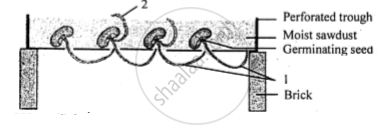
What is meant by ‘Positive’ and ‘Negative’ tropic movements in plants?
Define the following:
Organic food
Complete the following by filling in the blanks numbered 1 to 10 with the appropriate word/term:
Photosynthesis involves light reaction and dark reaction. During light reaction, the chlorophyll present in the (1) ______ gets activated by absorbing light energy. This energy splits (2) ______ molecules to (3) ______ and oxygen and releases two electrons. This process is called (4) ______. The (5) ______ ions are picked up by NADP to form (6) ______. The ADP is converted to (7) ______. This process is called (8) ______. During the dark phase, the compound produced at the end of the light reaction reacts with carbon dioxide to form (9) ______. This product is converted to starch. The process is called (10) ______.
What is the importance of photosynthesis in the life of the following:
Non-green plants
Explain the Term Calvin Cycle.
Mention, if the following statement is True or False. If false rewrite the wrong statement in its correct form:
KOH absorbs CO2.
Choose the Correct Answer:
Compensation point means the condition:
Why should the light-dependent reaction occur before the light-independent reaction?
Study the diagram given below and fill in the blanks with suitable words:
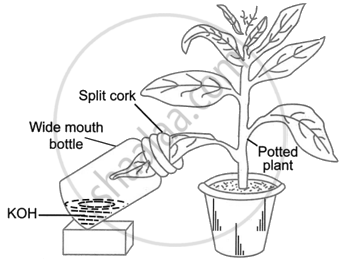
In order to prove that carbon dioxide is necessary for
(a) ______, a potted plant is placed in dark for 48 hours to (b) ______ the leaves. A part of a leaf is inserted into a conical flask containing potassium hydroxide solution. This is to absorb (c) ______ from the flask. The plant is then placed in sunlight for a few hours. The experimental leaf is tested for starch. The part of the leaf that was inside the conical flask turns (d) ______, whereas the part of the left outside turns (e) ______ in colour.
