Advertisements
Advertisements
Question
How does carbon dioxide return to the atmosphere? Explain.
A student in order to study the importance of certain factors of photosynthesis took a potted plant and kept it in the dark for over 24 hours. Then in the early hours of the morning the student covered one of the leaves with black paper in the centre only. Student placed the potted plant in the sunlight for a few hours, and then tested the leaf which was covered with black paper for starch.
(i) What aspect of photosynthesis was being investigated?
(ii) Is there any control in this experiment? If so, state the name.
(iii) Why was the plant kept in the dark before the experiment?
(iv) Describe step by step how the candidate proceeded to test the leaf for the presence of starch.
Advertisements
Solution
(a) Carbon dioxide is returned back to the atmosphere mainly through the following ways:
(i) Respiration - Animals and plants respire and release carbon dioxide in the atmosphere.
(ii) Decay - Plants and animals decay organic matter with the help of bacteria and fungi and release carbon dioxide.
(iii) Combustion - Plants and animals which got buried under the soil changed into coal and oil and releases carbon dioxide when these are burnt.
(iv) Ocean water - Carbon dioxide occurs in the form of lime stone in molluscan shells and as by product of photosynthesis in marine water.
(b) (i) To show that sunlight is needed for photosynthesis.
(ii) Yes, the uncovered portion of the experimental leaf is the control.
(iii) To destarch the leaf.
(iv) 1. Boil the leaf in alcohol.
2. Wash the leaf in water to make it soft.
3. Add iodine solution on the leaf. The portion uncovered shows blue-black colour and the portion covered shows brown colour. This indicates that sunlight is needed for photosynthesis.
APPEARS IN
RELATED QUESTIONS
Give suitable biological reasons for the following statement :
All life on Earth is supported by Photosynthesis.
The following statement is about photosynthesis in a green plant. Write whether it is True or False.
Photosynthesis occurs in underground organs as well as in aerial ones.
Choose the correct answer:
The process of photosynthesis occurs by _________
The number of water molecules required in the chemical reactions to produce one molecule of glucose during photosynthesis is
Name the following:
The first form of food substance produced during photosynthesis.
"Oxygen is a waste product of photosynthesis." Comment.
Complete the following food chain by writing the names of appropriate organisms in the blanks:
Grass → __________ → Snake → __________
What is photosynthesis and wherein a cell does occur?
A potted plant with variegated leafes was kept in dark for 24 hours and then placed in bright sunlight. Answer the following questions.
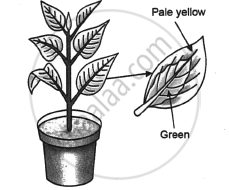
- Which aspect of photosynthesis is being tested in the above diagram?
- Why was the plant kept in the dark for 24 hours?
- After the starch test, what will be the colour of the yellow and green parts of the leaf? Give reasons to support your answer.
Distinguish between the following pairs on the basis of the word indicated in the bracket ( ).
Producers and Consumers (organisms)
