Advertisements
Advertisements
Question
The diagram given below represents an experiment to prove the importance of a factor in photosynthesis. Answer the questions that follow :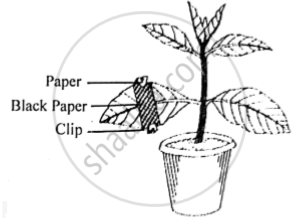
Explain the process of Photosynthesis.
Advertisements
Solution
Photosynthesis is a biochemical process by which green plants synthesises simple sugar in the presence of sunlight and chlorophyll using CO2 from the atmosphere and water from the soil.
APPEARS IN
RELATED QUESTIONS
Given below is an experiment setup to demonstrate a particualr tropic movement in germinating seeds. Study the diagram and answer the questions that follow :
Part 1 is affected by two stimuli. Name them. Which one of the two is stronger? 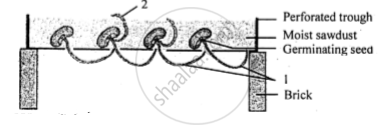
Part 1 is affected by two stimuli. Name them. Which one of the two is stronger?
The following statement is about photosynthesis in a green plant. Write whether it is True or False.
Photosynthesis occurs in underground organs as well as in aerial ones.
The diagram alongside represents an experiment conducted to prove the importance of a factor in photosynthesis.
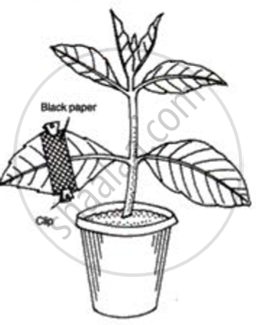
Study the same and then answer the questions that follow:
(i) Name the factor being studied in his experiment.
(ii) Why was the plant kept in a dark room before conducting the experiment?
(iii}Why was the experimental leaf then kept in
1. boiling water 2. methylated spirit?
(iv) Name the solution used to test for the presence of starch in the leaf.
(v) What will we observe in the experimental leaf at the end of the starch test?
(vi) Give a balanced chemical equation to represent the process of photosynthesis.
A plant is kept in a dark cupboard for 48 hours before conducting any experiment on photosynthesis in order to
Complete the following food chain by writing the names of appropriate organisms in the blanks:
Grass → __________ → Snake → __________
Complete the following sentence with appropriate word:
AIIP stands for ____________.
Mention, if the following statement is True or False. If false rewrite the wrong statement in its correct form:
Leaves are broad and flat to increase the surface area for photosynthesis.
The chemical reaction occurs during photosynthesis is ______.
What are primary producers?
Assertion (A): All food chains begin with herbivores.
Reason (R): Green plants are heterotrophs.
