Advertisements
Advertisements
Question
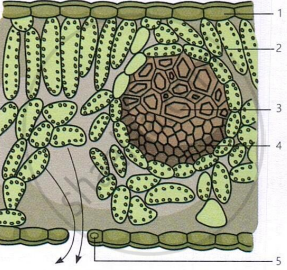
Fig. represents the vertical section of a leaf.
- Name the parts labelled 1 to 5.
- What do the two arrows (dotted and solid) indicate in the daytime and at night?
- Could you add one more arrow in the figure? If yes, what for?
Advertisements
Solution
-
- Upper Epidermis
- Palisade layer/chloroplast
- Xylem
- Phloem
- Guard cell
- The two arrows show the release of oxygen and water vapours during the daytime and carbon dioxide and very less amount of oxygen is released during the night.
- Yes, one more arrow can be added to show the absorption of carbon dioxide by the leaf.
APPEARS IN
RELATED QUESTIONS
Briefly explain the following terms: Photophosphorylation
Name the following:
The cell organelle responsible for photosynthesis.
The following statement is about photosynthesis in a green plant. Write whether it is True or False.
The raw materials for photosynthesis include water and carbon dioxide.
A candidate studied the importance of certain factors in photosynthesis. He took a potted plant and kept in the dark for over 24 hours. In the early hours of the next morning, he covered one of the leaves with black paper in the centre only. Then he placed the plant in sunlight for a few hours and tested the leaf which was covered with black paper for starch.
Describe step by step, how the candidate proceeded to test the leaf for the presence of starch?
Give technical term:
What does ATP abbreviate for?
Mention, if the following statement is True or False. If false rewrite the wrong statement in its correct form:
Radiant energy is converted into chemical energy by photosynthesis.
Mention, if the following statement is True or False. If false rewrite the wrong statement in its correct form:
A variegated leaf (one that has green as well as white patches) will only photosynthesize in the green areas.
Which one of the following is a primary producer?
In leaves, the food is stored in the form of ______.
Study the diagram given below and fill in the blanks with suitable words:
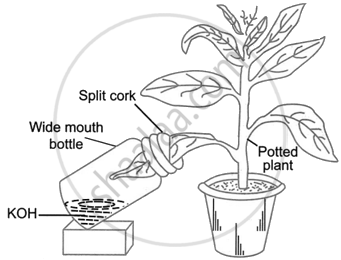
In order to prove that carbon dioxide is necessary for
(a) ______, a potted plant is placed in dark for 48 hours to (b) ______ the leaves. A part of a leaf is inserted into a conical flask containing potassium hydroxide solution. This is to absorb (c) ______ from the flask. The plant is then placed in sunlight for a few hours. The experimental leaf is tested for starch. The part of the leaf that was inside the conical flask turns (d) ______, whereas the part of the left outside turns (e) ______ in colour.
