Advertisements
Advertisements
प्रश्न
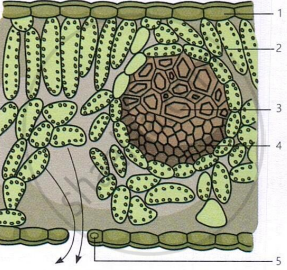
Fig. represents the vertical section of a leaf.
- Name the parts labelled 1 to 5.
- What do the two arrows (dotted and solid) indicate in the daytime and at night?
- Could you add one more arrow in the figure? If yes, what for?
Advertisements
उत्तर
-
- Upper Epidermis
- Palisade layer/chloroplast
- Xylem
- Phloem
- Guard cell
- The two arrows show the release of oxygen and water vapours during the daytime and carbon dioxide and very less amount of oxygen is released during the night.
- Yes, one more arrow can be added to show the absorption of carbon dioxide by the leaf.
APPEARS IN
संबंधित प्रश्न
Define the following:
Plant pigments
Describe an experiment to prove that sunlight is necessary for photosynthesis.
Fill in the blank:
CO2 enters the leaf through ______.
Complete the following food chains by writing the names of appropriate organisms in the blanks:
Grass → ______ → Snake → ______
How is the rate of photosynthesis affected when a green plant gets the green light?
Respiration is said to be the reversal of photosynthesis.
State whether true or false. If false, correct the statement.
Plants lose water when the stomata on leaves are closed.
Where does the carbon that is used in photosynthesis come from?
Why should the light-dependent reaction occur before the light-independent reaction?
An organism A which cannot move from one place to another makes a simple food B from the substances C and D available in the environment. This food is made in the presence of green-colored substance E present in organs F in the presence of light energy in a process called G. Some of the simple food B also gets converted into a complex food H for storage purposes. Does this food give a blue-black color with iodine solution?
a. What is
- organism A
- food B?
- food H?
b. What are C and D?
c. Name green-colored substance E and organ F.
d. What is the process G?
