Advertisements
Advertisements
प्रश्न
An experiment was set up as shown in the figure given below . The twig in the diagram was intact on the plant and it was as such in sunlight for a few hours .
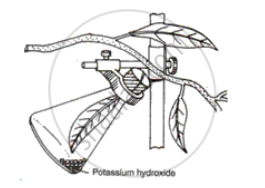
(i) What is the aim of the above experiment ?
(ii) Why was potassium hydroxide placed inside the conical flask ?
(iii) What test would you perform on the leaf inside the flask?
(iv) What is the expected result of the above test ?
(v) Is it necessary to similarly test on outer leaf also ? Giva a reason .
Advertisements
उत्तर
(i) The aim of the experiment is to prove that CO2 is necessary for photosynthesis.
(ii) Potassium hydroxide absorbs CO2 from the surrounding. It is placed to remove CO2 within the conical flask.
(iii) The leaf inside the conical flask would be tested for the presence of starch by the application of iodine.
(iv) The expected result of the above test is - No change in the colour will be observed.
(v) Yes, it is necessary to similarly test on the outer leaf also to show that leaves present in CO2 show photosynthesis.
APPEARS IN
संबंधित प्रश्न
Name the following:
The source of carbon dioxide for aquatic plants.
Given below is the representation of a certain phenomenon in nature. With four organisms 1-4.
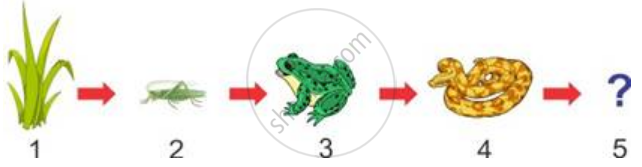
Name any one organism that could be shown at No .5
Given below is the representation of a certain phenomenon in nature. With four organisms 1-4.

Name the biological process which was the starting point of the whole chain.
A potted plant was taken in order to prove a factor necessary for photosynthesis. The potted plant was kept in the dark for 24 hours. One of the leaves was covered with black paper in the centre. The potted plant was then placed in sunlight for a few hours.
What aspect of photosynthesis was being tested?
Differentiate Between:
Light reaction and Dark reaction.
Name the following:
The green colouring matter of the plants.
Give technical term:
Name the experiment to demonstrate the importance of light for photosynthesis.
Name two plants having variegated leaves.
Given below is the figure of an experimental set-up, showing a physiological act of the plants. Study and answer the following questions:

- What is the objective of this experiment?
- Name and define the process shown here.
- Why do we destarch the leaves before performing the experiment?
- How do we destarch the leaves?
- What will be the observation when we pour iodine solution over the bleached experimental leaf?
- Write a well-balanced equation for the above process.
Given below is the diagram of an experimental set-up (final stage). Study the same and answer the following questions:

- What is the main aim of the experiment?
- Oxygen gas shown in the experiment is released from which of the raw materials?
- How would you confirm the presence of oxygen gas?
- Name the chemical substance which can be added in water to enhance the process/rate of release of oxygen gas.
- Draw a neat and labelled diagram of the same experiment for its initial stage.
