Advertisements
Advertisements
Question
Advertisements
Solution
Mitosis is important because:
(i) It helps in the growth of tissues, organs and thus the entire organism.
(ii) It helps in the repair of damaged tissues and organs.
(iii) It is the method by which lower organisms reproduce.
(iv) It helps in the maintenance of the hereditary characters by the replication of chromosomes.
APPEARS IN
RELATED QUESTIONS
The diagram given below represents a certain stage of mitosis:
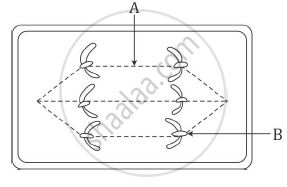
- Identify the stage of cell division.
- Name the parts labelled A and B.
- What is the unique feature observed in this stage?
- How many daughter cells are formed from this type of cell division?
Given below is a diagram representing a stage during mitotic cell division in an animal cell Examine it carefully and answer the questions which follow.

- Identify the stage. Give one reason in support of your answer.
- Name the cell organelle that forms the ‘aster’.
- Name the parts labelled 1, 2 and 3.
- Name the stage that follows the one shown above; how is that stage identified?
- Mention two differences between mitosis and meiosis with regards to:
- The number of daughter cells produced.
- The chromosome number in the daughter cells.
Genetic recombination occurs in ______ phase of prophase of meiosis-I.
Describe anaphase in mitosis.
Identify the stages of mitosis given below and label the figures.
Draw a well-labelled diagram to show the anaphase stage of mitosis in plant cells having four chromosomes.
Explain the Term Cell Diakinesis
Name the Following
The stage when chromosomes arrange at the equator.
Give Technical Terms
The stage in mitosis when the nucleolus starts disappearing.
Complete the following sentence with appropriate word :
Colchicine arrests cell division at __________.
Mention, if the following statement is True or False. If false rewrite the wrong statement in its correct form:
The alkaloid colchicine inhibits the formation of the mitotic spindle.
Multiple Choice Question:
The nuclear membrane and nucleolus become indistinguishable during
In which stage of mitosis the chromosomes align in an equatorial plate? How?
During Mitosis what is the position of chromatids in metaphase?
The phase of karyokinesis which is almost the reverse of prophase is ______.
