Advertisements
Advertisements
Question
Given below is a diagram representing a stage during mitotic cell division in an animal cell Examine it carefully and answer the questions which follow.

- Identify the stage. Give one reason in support of your answer.
- Name the cell organelle that forms the ‘aster’.
- Name the parts labelled 1, 2 and 3.
- Name the stage that follows the one shown above; how is that stage identified?
- Mention two differences between mitosis and meiosis with regards to:
- The number of daughter cells produced.
- The chromosome number in the daughter cells.
Advertisements
Solution
- Prophase: The nuclear membrane disappears.
- Centrioles
-
- Centromere
- Sister chromatids.
- Spindle fibre.
- Metaphase: The centromeres of chromosomes are drawn to the equator by the equal pull of two chromosomal spindle fibres that connect each centromere to the opposite poles.
forming a metaphasic plate. -
- Mitosis:
- Two daughter cells are produced.
- The number of chromosomes is the same as that of the parent cell.
- Meiosis:
- Four daughter cells are produced.
- Half the number of chromosomes as that of the parent cell.
- Mitosis:
APPEARS IN
RELATED QUESTIONS
For formation of plasma membrane, ______ molecules are necessary.
Describe anaphase in mitosis.
Define the following:
Karyokinesis
The fig given alongside shows a certain stage in a cell division in a cell with four chromosomes.
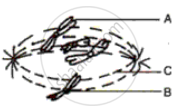
(i) Name the parts of the chromosome labeled A and B.
(ii) Name the structure C. what is its function?
(iii) Name the type of division . Give a reason.
(iv) Name the stage of division.
(v) Name the stages before and after the stage shown in diagram.
Choose the correct answer:
Nuclear membrane reappears in ____________
Draw a labeled schematic representation of mitosis cell division.
Explain the Term Cell Diakinesis
Name the following:
The kind of division normally seen at the tip of the root and shoot system.
Name the Following
Nuclear envelope and nucleoli reappear in which stage.
Give Technical Terms
The stage in mitosis when the nucleolus starts disappearing.
Complete the following sentence with appropriate word :
______means the splitting of the nucleus.
Complete the following sentence with appropriate word :
Colchicine arrests cell division at __________.
Choose the Odd One Out
Multiple Choice Question:
The nuclear membrane disappears in
Write the functional activity of the following structure:
Colchicine
In which stage of mitosis the chromosomes align in an equatorial plate? How?
Give the sequence of the events occurring during the prophase of mitosis.
