Advertisements
Advertisements
Question
Define the following:
Karyokinesis
Advertisements
Solution
Karyokinesis - It is the nuclear division where nucleus divides into two.
APPEARS IN
RELATED QUESTIONS
The diagram given below represents a certain stage of mitosis:
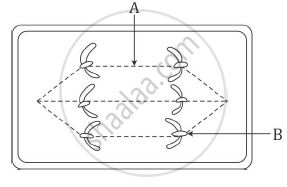
- Identify the stage of cell division.
- Name the parts labelled A and B.
- What is the unique feature observed in this stage?
- How many daughter cells are formed from this type of cell division?
With the help of suitable diagrams, explain the five stages of prophase-I of meiosis.
Choose the correct answer:
Nuclear membrane reappears in ____________
In which one of the following options the two stages of mitosis have been given in correct sequence?
Differentiate between centrosome and centromere.
Draw a labeled schematic representation of mitosis cell division.
Draw a well-labelled diagram to show the anaphase stage of mitosis in plant cells having four chromosomes.
Explain the Term Cell Diakinesis
Name the Following
Name the stage during which nuclear membrane and nucleoli reappear.
Name the Following
Nuclear envelope and nucleoli reappear in which stage.
Give Technical Terms
Division of nucleus.
Complete the following sentence with appropriate word :
______means the splitting of the nucleus.
Complete the following sentence with appropriate word :
Colchicine arrests cell division at __________.
Multiple Choice Question:
The nuclear membrane disappears in
The karyotype (set of chromosomes) shown below is taken from a dividing cell in a certain individual.
(i) Is the individual male or female? Explain your answer.
(ii) How would you expect
(a) a female cell and
(b) sperm cell to differ in chromosome composition?
Explain the following figure.

In which stage of mitosis the chromosomes align in an equatorial plate? How?
What is the main function of the spindle fibres during mitosis?
