Advertisements
Advertisements
Questions
Differentiate between centrosome and centromere.
Distinguish between the following pair:
Centrosome and Centromere
Advertisements
Solution
| Centrosome | Centromere |
| It is an organelle of the animal cell. | It is a non-stainable part of the chromosome at which two chromatids join. |
| It contains two centrioles, which move towards the opposite poles and form spindle fibres during cell division | It provides attachment of spindle fibres during cell division. |
| They are responsible for the inheritance of characters from parents to offspring. Chromosomes also help in cell division and control various metabolic activities. | It is the region of attachment of the sister chromatids and also the site of attachment to the spindle fibre. |
APPEARS IN
RELATED QUESTIONS
The diagram given below represents a certain stage of mitosis:
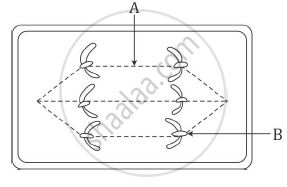
- Identify the stage of cell division.
- Name the parts labelled A and B.
- What is the unique feature observed in this stage?
- How many daughter cells are formed from this type of cell division?
Genetic recombination occurs in ______ phase of prophase of meiosis-I.
Define the following:
Karyokinesis
The diagram given alongside represents a stage in cell division.
Study the same and answer the questions that follow:
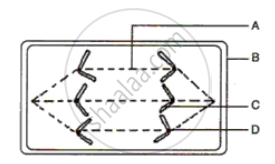
(i) Identify the stage of cell division.
(ii) Name the parts labeled A,B,C and D.
(iii) What is the unique feature observed in this stage?
(iv) Where does this type of cell division usually occur?
(v) How many daughter cells are formed from this type of cell division?
(vi) Is the dividing cell shown a plant or an animal cell?
Give a reason to support your answer.
The fig given alongside shows a certain stage in a cell division in a cell with four chromosomes.
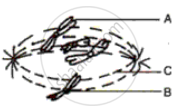
(i) Name the parts of the chromosome labeled A and B.
(ii) Name the structure C. what is its function?
(iii) Name the type of division . Give a reason.
(iv) Name the stage of division.
(v) Name the stages before and after the stage shown in diagram.
Choose the correct answer:
Which division takes most time?
Name the following:
The kind of division normally seen at the tip of the root and shoot system.
Name the Following
The stage when chromosomes arrange at the equator.
Give Technical Terms
The stage in mitosis when the nucleolus starts disappearing.
Mention, if the following statement is True or False. If false rewrite the wrong statement in its correct form:
The alkaloid colchicine inhibits the formation of the mitotic spindle.
Multiple Choice Question:
Karyokinesis is the division of
Multiple Choice Question:
The nuclear membrane and nucleolus become indistinguishable during
In which stage of mitosis the chromosomes align in an equatorial plate? How?
Give the sequence of the events occurring during the prophase of mitosis.
The diagram given below represents a stage in mitosis.

- Identify the stage given above.
- Give one reason to support your answer in (a).
- Mention the number of chromosomes given in the diagram.
Name these:
Two steps of the process Mitosis
