Advertisements
Advertisements
Question
The diagram given alongside represents a stage in cell division.
Study the same and answer the questions that follow:
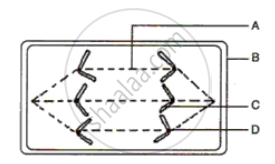
(i) Identify the stage of cell division.
(ii) Name the parts labeled A,B,C and D.
(iii) What is the unique feature observed in this stage?
(iv) Where does this type of cell division usually occur?
(v) How many daughter cells are formed from this type of cell division?
(vi) Is the dividing cell shown a plant or an animal cell?
Give a reason to support your answer.
Advertisements
Solution
(i) Anaphase in a plant cell
(ii) A - Spindle fibre
B - Cell wall
(iii) The homologous daughter chromatids or chromosomes begin to move towards opposite poles.
(iv) This type of cell division occurs usually in the somatic cells.
(v) Two daughter cells are formed from this type of cell division.
(vi) The dividing cell shown is a plant cell because of the presence of cell wall and the absence of centriole.
RELATED QUESTIONS
Fill in the blank:
______ is the indirect cell division.
The fig given alongside shows a certain stage in a cell division in a cell with four chromosomes.
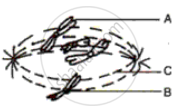
(i) Name the parts of the chromosome labeled A and B.
(ii) Name the structure C. what is its function?
(iii) Name the type of division . Give a reason.
(iv) Name the stage of division.
(v) Name the stages before and after the stage shown in diagram.
Choose the correct answer:
Which division takes most time?
Name the following:
Mitosis takes place in which cells.
Name the following:
The kind of division normally seen at the tip of the root and shoot system.
Name the Following
Name the stage during which nuclear membrane and nucleoli reappear.
Choose the Odd One Out
Multiple Choice Question:
Karyokinesis is the division of
Multiple Choice Question:
The nuclear membrane disappears in
Identify the stage of mitosis from the below picture. List the chromosomal events in this stage.
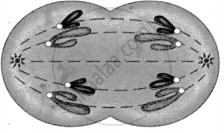
The phase of karyokinesis which is almost the reverse of prophase is ______.
Match List - I with List - II.
| List - I | List - II |
| A. Centromere | I. Mitochondrion |
| B. Cilium | II. Cell division |
| C. Cristae | III. Сell movement |
| D. Cell membrane | IV. Phospholipid Bilayer |
Choose the correct answer from the options given below:
