Advertisements
Advertisements
Question
Advertisements
Solution
Different steps of mitosis :

(a) Prophase

(b) Metaphase
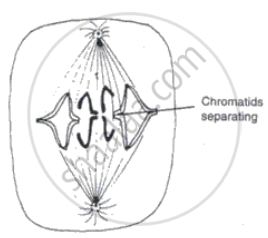
(c) Early anaphase
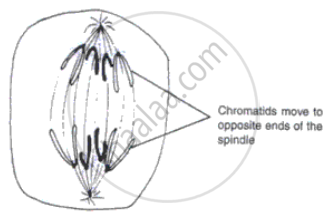
(d) Anaphase
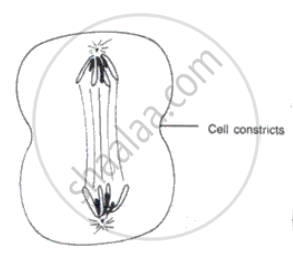
(e) Late anaphase

(f) Telophase
APPEARS IN
RELATED QUESTIONS
The diagram given below represents a certain stage of mitosis:
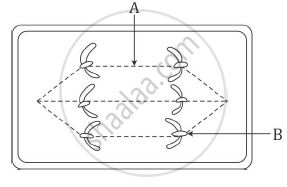
- Identify the stage of cell division.
- Name the parts labelled A and B.
- What is the unique feature observed in this stage?
- How many daughter cells are formed from this type of cell division?
Fill in the blank:
______ takes place in body cells resulting in growth and development.
Identify the stages of mitosis given below and label the figures.
The figure below shows a certain stage of mitosis:
(i) Name the stage,
(ii) Label the parts 1 to 4
(iii) How many chromosomes are shown here?
Draw a well-labelled diagram to show the anaphase stage of mitosis in plant cells having four chromosomes.
Explain the Term Pachytene
Explain the Term Cell Diakinesis
Name the Following
The stage when chromosomes arrange at the equator.
Give Technical Terms
The stage in mitosis when the nucleolus starts disappearing.
Give Technical Terms
The stage at which spindle fibres begin to be formed.
Give Technical Terms
Division of nucleus.
Complete the following sentence with appropriate word :
Colchicine arrests cell division at __________.
Multiple Choice Question:
The nuclear membrane and nucleolus become indistinguishable during
Column ‘II’ is a list of items related to ideas in Column ‘I’. Match the terms in Column ‘II’ with a suitable idea given in Column ‘I’.
| Column I | Column II |
| (i) Anaphase | (a) Chromosomes become arranged in a horizontal plane at the equator. |
| (ii) Prophase | (b) Daughter chromosomes move to opposite poles of the spindle. |
| (iii) Telophase | (c) Chromosomes become visible as fine, long threads. |
| (iv) Metaphase | (d) Chromosomes lose their distinctiveness and gradually become transformed into chromatin network. |
Explain the following figure.

Identify the stage of mitosis from the below picture. List the chromosomal events in this stage.
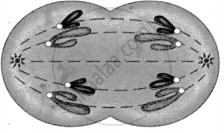
The diagram given below represents a stage in mitosis.

- Identify the stage given above.
- Give one reason to support your answer in (a).
- Mention the number of chromosomes given in the diagram.
During Mitosis what is the position of chromatids in metaphase?
