Advertisements
Advertisements
Question
Give Technical Terms
The stage in mitosis when the nucleolus starts disappearing.
Advertisements
Solution
Prophase
RELATED QUESTIONS
The diagram given below represents a certain stage of mitosis:
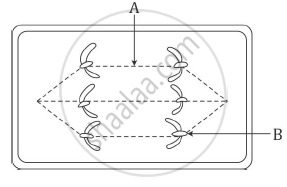
- Identify the stage of cell division.
- Name the parts labelled A and B.
- What is the unique feature observed in this stage?
- How many daughter cells are formed from this type of cell division?
Given below is a diagram representing a stage during mitotic cell division in an animal cell Examine it carefully and answer the questions which follow.

- Identify the stage. Give one reason in support of your answer.
- Name the cell organelle that forms the ‘aster’.
- Name the parts labelled 1, 2 and 3.
- Name the stage that follows the one shown above; how is that stage identified?
- Mention two differences between mitosis and meiosis with regards to:
- The number of daughter cells produced.
- The chromosome number in the daughter cells.
All chromosomes are arranged parallel to equatorial plane of cell in ______ phase of mitosis.
With the help of suitable diagrams, explain the five stages of prophase-I of meiosis.
Differentiate between centrosome and centromere.
Draw a labeled schematic representation of mitosis cell division.
Name the following:
Mitosis takes place in which cells.
Name the following:
Replacement of dead cells is accomplished by which process.
Name the Following
Name the stage during which nuclear membrane and nucleoli reappear.
Identify the stage of mitosis from the below picture. List the chromosomal events in this stage.
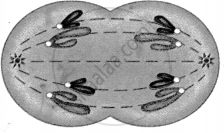
The diagram given below represents a stage in mitosis.

- Identify the stage given above.
- Give one reason to support your answer in (a).
- Mention the number of chromosomes given in the diagram.
The phase of karyokinesis which is almost the reverse of prophase is ______.
Name these:
Two steps of the process Mitosis
