Advertisements
Advertisements
Question
Give Technical Terms
Division of nucleus.
Advertisements
Solution
Karyokinesis
RELATED QUESTIONS
Given below is a diagram representing a stage during mitotic cell division in an animal cell Examine it carefully and answer the questions which follow.

- Identify the stage. Give one reason in support of your answer.
- Name the cell organelle that forms the ‘aster’.
- Name the parts labelled 1, 2 and 3.
- Name the stage that follows the one shown above; how is that stage identified?
- Mention two differences between mitosis and meiosis with regards to:
- The number of daughter cells produced.
- The chromosome number in the daughter cells.
All chromosomes are arranged parallel to equatorial plane of cell in ______ phase of mitosis.
With the help of suitable diagrams, explain the five stages of prophase-I of meiosis.
Define the following:
Karyokinesis
Fill in the blank:
______ takes place in body cells resulting in growth and development.
The fig given alongside shows a certain stage in a cell division in a cell with four chromosomes.
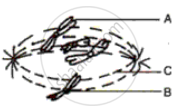
(i) Name the parts of the chromosome labeled A and B.
(ii) Name the structure C. what is its function?
(iii) Name the type of division . Give a reason.
(iv) Name the stage of division.
(v) Name the stages before and after the stage shown in diagram.
Choose the correct answer:
Nuclear membrane reappears in ____________
In which one of the following options the two stages of mitosis have been given in correct sequence?
Differentiate between centrosome and centromere.
The figure below shows a certain stage of mitosis:
(i) Name the stage,
(ii) Label the parts 1 to 4
(iii) How many chromosomes are shown here?
Name the following:
Mitosis takes place in which cells.
Multiple Choice Question:
Karyokinesis is the division of
Multiple Choice Question:
The nuclear membrane disappears in
The diagram given below represents a stage in mitosis.

- Identify the stage given above.
- Give one reason to support your answer in (a).
- Mention the number of chromosomes given in the diagram.
During Mitosis what is the position of chromatids in the anaphase?
Name these:
Two steps of the process Mitosis
