Advertisements
Advertisements
प्रश्न
Advertisements
उत्तर
Different steps of mitosis :

(a) Prophase

(b) Metaphase
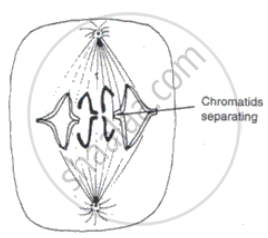
(c) Early anaphase
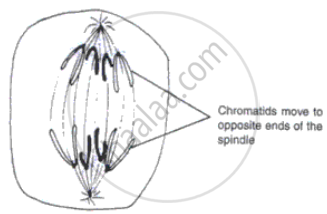
(d) Anaphase
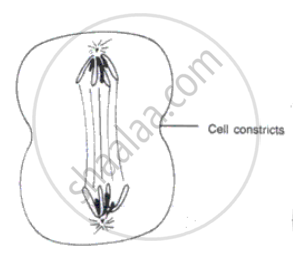
(e) Late anaphase

(f) Telophase
APPEARS IN
संबंधित प्रश्न
Given below is a diagram representing a stage during mitotic cell division in an animal cell Examine it carefully and answer the questions which follow.

- Identify the stage. Give one reason in support of your answer.
- Name the cell organelle that forms the ‘aster’.
- Name the parts labelled 1, 2 and 3.
- Name the stage that follows the one shown above; how is that stage identified?
- Mention two differences between mitosis and meiosis with regards to:
- The number of daughter cells produced.
- The chromosome number in the daughter cells.
The fig given alongside shows a certain stage in a cell division in a cell with four chromosomes.
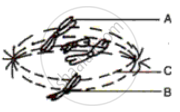
(i) Name the parts of the chromosome labeled A and B.
(ii) Name the structure C. what is its function?
(iii) Name the type of division . Give a reason.
(iv) Name the stage of division.
(v) Name the stages before and after the stage shown in diagram.
Choose the correct answer:
Which division takes most time?
Choose the correct answer:
Nuclear membrane reappears in ____________
In which one of the following options the two stages of mitosis have been given in correct sequence?
Differentiate between centrosome and centromere.
The diagram below represents a certain stage of a cell.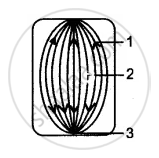
(i) Is it an animal cell or a plant cell ? Give one reason in support of your answer.
(ii) Label the parts numbered 1 – 3.
(iii) Which stage (phase) of mitosis is represented in this diagram
Explain the Term Pachytene
Name the following:
Mitosis takes place in which cells.
Name the following:
The kind of division normally seen at the tip of the root and shoot system.
Name the Following
The stage when chromosomes arrange at the equator.
Give Technical Terms
The stage in mitosis when the nucleolus starts disappearing.
Give Technical Terms
Division of nucleus.
Column ‘II’ is a list of items related to ideas in Column ‘I’. Match the terms in Column ‘II’ with a suitable idea given in Column ‘I’.
| Column I | Column II |
| (i) Anaphase | (a) Chromosomes become arranged in a horizontal plane at the equator. |
| (ii) Prophase | (b) Daughter chromosomes move to opposite poles of the spindle. |
| (iii) Telophase | (c) Chromosomes become visible as fine, long threads. |
| (iv) Metaphase | (d) Chromosomes lose their distinctiveness and gradually become transformed into chromatin network. |
The karyotype (set of chromosomes) shown below is taken from a dividing cell in a certain individual.
(i) Is the individual male or female? Explain your answer.
(ii) How would you expect
(a) a female cell and
(b) sperm cell to differ in chromosome composition?
In which stage of mitosis the chromosomes align in an equatorial plate? How?
During Mitosis what is the position of chromatids in metaphase?
Match List - I with List - II.
| List - I | List - II |
| A. Centromere | I. Mitochondrion |
| B. Cilium | II. Cell division |
| C. Cristae | III. Сell movement |
| D. Cell membrane | IV. Phospholipid Bilayer |
Choose the correct answer from the options given below:
