Advertisements
Advertisements
Question
What would happen to the root hair of a potted plant if the soil was watered with an extremely concentrated solution of sodium chloride?
Advertisements
Solution
If the soil was watered with extremely concentrated solution of sodium chloride, the water will move out from the root hair due to osmosis and thus, plasmolysis will take place.
APPEARS IN
RELATED QUESTIONS
Root hairs become flaccid, when fertilizers are added to the moist soil around it. Explain.
The figure given below is a diagrammatic representation of a part of the cross-section of the root in the root hair zone. Study the same and then answer the questions that follow :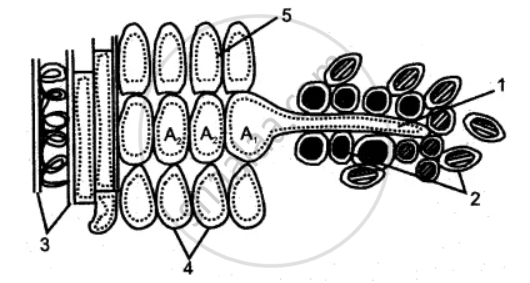
(i) Name the parts indicated by guidelines ‘1’ to ‘5’
(ii) Is the root hair cell unicellular or multi-cellular?
(iii) Draw a labeled diagram of the root hair cell as it would appear if some fertilizer is added to the soil close to it.
(iv) Name the process responsible for the entry of water molecules from the soil into A1 and then A2.
(v) What pressure is responsible for the movement of water in the direction indicated by arrows?
(vi) How is this pressure set up?
Inner layer of root hair is made up of ______.
From which type of cells, root hair is originated
Which of the following are the components of cell wall of root hair?
____________plants like orchids absorb water vapours from air with the help of epiphytic roots having special tissue called velamen.
Aquatic animals like fish excrete their wastes in gaseous form as ______.
