Advertisements
Advertisements
Question
Define the term:
Plasmolysis
Advertisements
Solution
APPEARS IN
RELATED QUESTIONS
The following diagram represents a plant cell after being placed in a strong sugar solution.
 Guidelines 1 to 5 indicate the following
(1)Cell wall, (2) Strong sugar solution, (3) Protoplasm (4) Large vacuole, (5) Nucleus
(1)What is the state of the cell shown in the cell shown in the diagram?
(2)Name the structure which acts as a selectively permeable membrane.
(3)If the cell had been placed in distilled water instead of strong sugar solution, which feature would not have been seen?
(4)Name any one feature of this plant cell which is not present in an animal cell.
The diagram given below represents an experimental set-up to demonstrate a certain process. Study the same and answer the questions that follow:
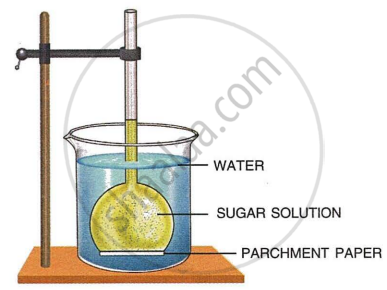
- Name the process.
- Define the above-named process.
- What would you observe in the experimental set-up after an hour or so?
- What control experiment can be set up for comparison?
- Keeping in mind the root hair, cell and its surroundings, name the parts that correspond to
- concentrated sugar solution
- parchment paper
- water in the beaker
- Name any other material that can be used instead of parchment paper in the above experiment.
- Mention two advantages of the process for the plants.
Name the following:
The pressure with which the molecules of a substance diffuse.
Explain why:
The leaves of wilted lettuce, if kept in cold water, become crisp.
Two potato cubes each 1 cm3 in size, were placed separately in two containers (A and B), the container A having water and the other (B) containing concentrated sugar solution. After 24 hours when the cubes were examined, those placed in water were found to be firm and had increased slightly in size and those placed in concentrated sugar solution were found to be soft and somewhat decreased in size. Use the above information to answer the questions that follow:
Name and define the physical process being investigated in this experiment.
A leaf cell of a water plant was placed in a liquid other than pond water. After sometime, it assumed a shape as shown below:

Redraw in the space provided, the diagram of the cell if it is soon placed in ordinary water for some time.
Give Reasons for the following.
Plants growing in fertilized soil are often found to wilt if the soil is not adequately watered. Why?
In the figure below ‘A’ shows a cell in the normal state and ‘B’ shows the same cell after leaving it in a certain solution for a few minutes.

(i) Describe the change which has occurred in the cell as seen in B.
(ii) Give the technical term for the condition of the cell as reached in B and as it was in A.
(iii) Define the process which led to this condition.
(iv) What was the solution-isotonic, hypotonic or hypertonic, in which the cell was kept?
(v) How can the cell in B, be brought back to its original condition?
(vi) Name the parts numbered 1 to 3.
A plant cell kept in a drop of water was examined under the low power magnification of a microscope, as shown:
(i) What would you do to bring this cell back to its original condition?
(ii) What scientific term is used for such condition?
(iii) Draw the same cell if it is kept in a strong sugar solution.
Given below is the figure of an experimental set up to demonstrate root pressure.
(i) Define root pressure.
(ii) What change would you observe in the water level after some time?
(iii) What role is being played by the root pressure in the given experiment?
(iv) Why the oil has been sprinkled on water?
Name the following:
Name the process by which water enters the root hair cell.
Fill in the Blank
A plasmolysed cell has __________ protoplast.
Fill in the Blanks
Diffusion is the movement of molecules from a region of their ________ concentration to the region of their ________ concentration.
Multiple Choice Question:
Marine fish when thrown under tap water bursts because of:
Explain the term:
Diffusion
Explain the term:
Plasmolysis
During a practical exam, a plant cell in a particular solution was placed under a compound microscope. Students were told to observe the cell and name the tonicity of the solution and mention the process that occurred in the cell.
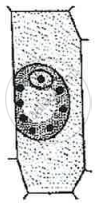
When a cell in solution shrinks and loses its shape, then the solution is ______.
Define the following term:
Osmotic Pressure
