Advertisements
Advertisements
Question
Fill in the Blank
The pressure which develops in the cortical cells of root which force a part of the water upward ____________.
Advertisements
Solution
The pressure which develops in the cortical cells of root which force a part of the water upward Root pressure.
RELATED QUESTIONS
A candidate in order to study the process of osmosis has taken 3 potato cubes and put them in 3 different beakers containing 3 different solutions. After 24 hours, in the first beaker the potato cube increased in size, in the second beaker the potato cube decreased in size and in the third beaker there was no change in the size of the potato cube. The following diagram shows the result of the same experiment:

(i) Give the technical terms of the solutions used in beakers, 1, 2 and 3.
(ii) In beaker 3, the size of the potato cube remains the same. Explain the reason in brief.
(iii) Write the specific feature of the cell sap of root hairs which helps in absorption of water.
(iv) What is osmosis?
(v) How does a cell wall and a cell membrane differ in their permeability?
Leaves of the sensitive plant wilt and droop down on a slight touch. What mechanism brings about this change?
The diagram given below represents an experimental set-up to demonstrate a certain process. Study the same and answer the questions that follow:
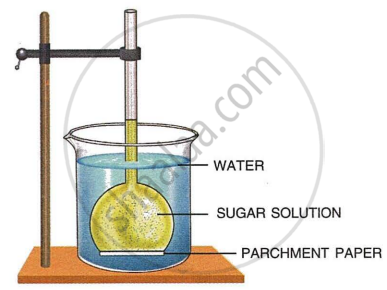
- Name the process.
- Define the above-named process.
- What would you observe in the experimental set-up after an hour or so?
- What control experiment can be set up for comparison?
- Keeping in mind the root hair, cell and its surroundings, name the parts that correspond to
- concentrated sugar solution
- parchment paper
- water in the beaker
- Name any other material that can be used instead of parchment paper in the above experiment.
- Mention two advantages of the process for the plants.
Define the following:
Hypertonic solution
Give Reasons for the following.
On sprinkling common salt on grass growing in a lawn, the grass is killed.
Differentiate between:
Osmosis and Diffusion
The diagram given below is of an experiment just at the start. Study the diagram carefully and answer the following questions :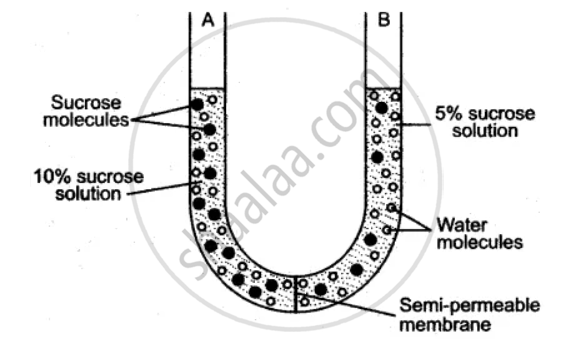
(i) What does the experiment demonstrate?
(ii) Define, the process demonstrated in the experiment.
(iii) What changes are observed after a few hours?
(iv) Give two examples of a semi-permeable membrane.
(v) Which limb of the U-tube contains a more concentrated sucrose solution, A or B?
(vi) Why is the membrane separating the two solutions labeled as semi-permeable membrane?
In an experiment, two sets of apparatus were set up as shown below:
In A there is a concentrated sugar solution inside the thistle funnel and red ink in the water outside the funnel. In B there is a concentrated glucose solution with red ink inside the thistle funnel and water outside the thistle funnel.
In both A and B the level of liquid inside the funnels rises up the tubes. In A the sugar solution turns red and in B, the water turns red.
Study the given observations and answer these questions:

- Name the process by which red ink moves in A and B.
- Which type of pressure forces the water molecules to move towards thistle funnels and cause a rise in the water level?
- Where does this process occur in plants and animals?
- What material could be used as a semi-permeable membrane?
Give Technical Term for the following.
The condition in which the water from a cell is completely removed due to exosmosis and no more shrinkage is possible.
Fill in the Blanks
Diffusion is the movement of molecules from a region of their ________ concentration to the region of their ________ concentration.
