Advertisements
Advertisements
Question
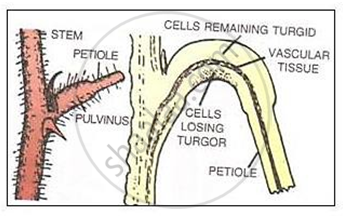
Leaves of the sensitive plant wilt and droop down on a slight touch. What mechanism brings about this change?
Advertisements
Solution
Leaves of the sensitive plant wilt and droop down on a slight touch due to turgor movement. Petiole of sensitive plant is held up by turgid pulvinus tissue. The stimulus of touch leads to loss of turgor at the base of the leaflets and at the base of the petioles i.e. pulvinus. The cells of the lower side of pulvinus lose water and the petiole collapses. This causes the wilting and drooping of the leaves
RELATED QUESTIONS
The highest water potential (capacity to move out higher concentrated solution) is that of ______.
The most appropriate characteristic of a semipermeable membrane is that
The following diagram represents a plant cell after being placed in a strong sugar solution.
 Guidelines 1 to 5 indicate the following
(1)Cell wall, (2) Strong sugar solution, (3) Protoplasm (4) Large vacuole, (5) Nucleus
(1)What is the state of the cell shown in the cell shown in the diagram?
(2)Name the structure which acts as a selectively permeable membrane.
(3)If the cell had been placed in distilled water instead of strong sugar solution, which feature would not have been seen?
(4)Name any one feature of this plant cell which is not present in an animal cell.
Define the following:
Diffusion
What is the significance of diffusion?
Give Reasons for the following.
Freshwater fish cannot survive in seawater.
Mention, if the following statement is True or False. If false rewrite the wrong statement in its correct form:
The plasma membrane permits the passage of all solutes and water.
Explain the Term: Endosmosis
