Advertisements
Advertisements
Question
The beaker is divided into two chambers A and B. The big circle represents solute and the small circles solvent.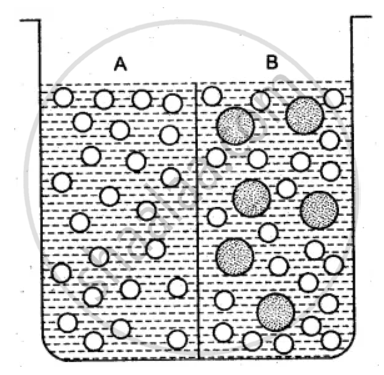
(i) What can you say about the size of the holes in the membrane, if it is to behave semi- permeably between these two?
(ii) Will the solvent molecules pass through the membrane from left to right, from right to left, in either direction or in both directions?
(iii) In which direction will there be a net movement of solvent molecules?
Advertisements
Solution
(i) The size of the holes in the membrane is large enough to allow only the solvent particles to pass through it. But solute particle cannot pass through it. Thus, the membrane acts as the semi-permeable.
(ii) Solvent molecules will pass through the membrane in both directions. Since solvent molecules are present on both the sides they will strike the semi-permeable membrane and pass through the same.
(iii) There is a net movement of solvent molecules from the place of its higher chemical potential to the place of its lower chemical potential, i.e., from right to left.
RELATED QUESTIONS
The space between the cell wall and plasma membrane in a plasmolysed cell is filled with ______.
Define the following:
Hypertonic solution
Name the following:
The process by which raisins swell up when placed in a beaker of water.
Choose the correct answer:
If a marine plant is transferred to fresh water, it bursts due to ___________
Give Reasons for the following.
The raisins swell up in the water.
The diagram given below is of an experiment just at the start. Study the diagram carefully and answer the following questions :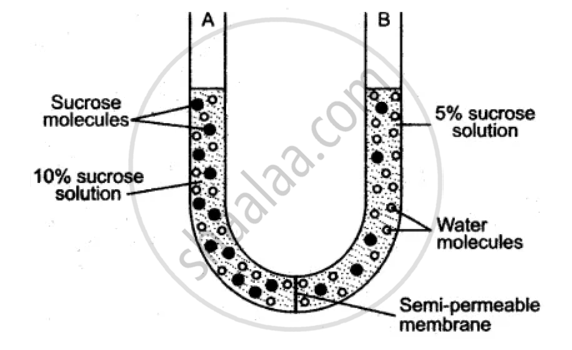
(i) What does the experiment demonstrate?
(ii) Define, the process demonstrated in the experiment.
(iii) What changes are observed after a few hours?
(iv) Give two examples of a semi-permeable membrane.
(v) Which limb of the U-tube contains a more concentrated sucrose solution, A or B?
(vi) Why is the membrane separating the two solutions labeled as semi-permeable membrane?
The apparatus arranged here signifies an important process.
(i) Name the process.
(ii) Where does this process occur in plants?
(iii) What solution is placed inside the dialysis tubing?
(iv) What happens to the level of the solution in the capillary tube?
(v) Define the process mentioned in Q. (i) above.
Name the following:
The pressure through which water can rise upto some feet.
Name the following:
Condition of cell in which the cell content are shrunken.
Fill in the Blanks
Diffusion is the movement of molecules from a region of their ________ concentration to the region of their ________ concentration.
