Advertisements
Advertisements
प्रश्न
The beaker is divided into two chambers A and B. The big circle represents solute and the small circles solvent.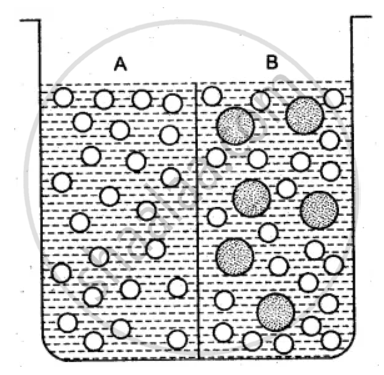
(i) What can you say about the size of the holes in the membrane, if it is to behave semi- permeably between these two?
(ii) Will the solvent molecules pass through the membrane from left to right, from right to left, in either direction or in both directions?
(iii) In which direction will there be a net movement of solvent molecules?
Advertisements
उत्तर
(i) The size of the holes in the membrane is large enough to allow only the solvent particles to pass through it. But solute particle cannot pass through it. Thus, the membrane acts as the semi-permeable.
(ii) Solvent molecules will pass through the membrane in both directions. Since solvent molecules are present on both the sides they will strike the semi-permeable membrane and pass through the same.
(iii) There is a net movement of solvent molecules from the place of its higher chemical potential to the place of its lower chemical potential, i.e., from right to left.
संबंधित प्रश्न
Movement of molecules of a substance from the region of their higher concentration to the region of their lower concentration without the involvement a separating membrane, is called
Define the following:
Diffusion
Explain why:
The leaves of wilted lettuce, if kept in cold water, become crisp.
What is the water potential?
Give Reasons for the following.
It is necessary to maintain a normal osmotic concentration of the blood.
The apparatus arranged here signifies an important process.
(i) Name the process.
(ii) Where does this process occur in plants?
(iii) What solution is placed inside the dialysis tubing?
(iv) What happens to the level of the solution in the capillary tube?
(v) Define the process mentioned in Q. (i) above.
Given below is the figure of an experimental set up to demonstrate root pressure.
(i) Define root pressure.
(ii) What change would you observe in the water level after some time?
(iii) What role is being played by the root pressure in the given experiment?
(iv) Why the oil has been sprinkled on water?
Name the following:
The movement of a liquid through a selectively permeable membrane.
During a practical exam, a plant cell in a particular solution was placed under a compound microscope. Students were told to observe the cell and name the tonicity of the solution and mention the process that occurred in the cell.