Advertisements
Advertisements
प्रश्न
The beaker is divided into two chambers A and B. The big circle represents solute and the small circles solvent.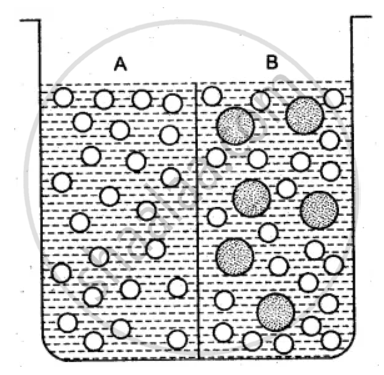
(i) What can you say about the size of the holes in the membrane, if it is to behave semi- permeably between these two?
(ii) Will the solvent molecules pass through the membrane from left to right, from right to left, in either direction or in both directions?
(iii) In which direction will there be a net movement of solvent molecules?
Advertisements
उत्तर
(i) The size of the holes in the membrane is large enough to allow only the solvent particles to pass through it. But solute particle cannot pass through it. Thus, the membrane acts as the semi-permeable.
(ii) Solvent molecules will pass through the membrane in both directions. Since solvent molecules are present on both the sides they will strike the semi-permeable membrane and pass through the same.
(iii) There is a net movement of solvent molecules from the place of its higher chemical potential to the place of its lower chemical potential, i.e., from right to left.
संबंधित प्रश्न
Movement of molecules of a substance from the region of their higher concentration to the region of their lower concentration without the involvement a separating membrane, is called
The most appropriate characteristic of a semipermeable membrane is that
Distinguish between the following:
Turgor pressure and osmotic pressure
Distinguish between the following:
Plasmolysis and deplasmolysis
What is the significance of diffusion?
Give Reasons for the following.
The raisins swell up in the water.
Give Reasons for the following.
Plants growing in fertilized soil are often found to wilt if the soil is not adequately watered. Why?
Name the following:
The process by which raisins swell up when placed in a beaker of water.
Fill in the Blank
The pressure which develops in the cortical cells of root which force a part of the water upward ____________.
Mention, if the following statement is True or False. If false rewrite the wrong statement in its correct form:
Cells that have lost their water content are said to be deplasmolysed.
