Advertisements
Advertisements
प्रश्न
In an experiment, two sets of apparatus were set up as shown below:
In A there is a concentrated sugar solution inside the thistle funnel and red ink in the water outside the funnel. In B there is a concentrated glucose solution with red ink inside the thistle funnel and water outside the thistle funnel.
In both A and B the level of liquid inside the funnels rises up the tubes. In A the sugar solution turns red and in B, the water turns red.
Study the given observations and answer these questions:

- Name the process by which red ink moves in A and B.
- Which type of pressure forces the water molecules to move towards thistle funnels and cause a rise in the water level?
- Where does this process occur in plants and animals?
- What material could be used as a semi-permeable membrane?
Advertisements
उत्तर
(i) Osmosis.
(ii) Osmotic pressure.
(iii) In plants, in the root cells and in animals in the RBC’s.
(iv) Cellophane paper or goat bladder, etc.
संबंधित प्रश्न
Give the appropriate biological or technical term for the following.
Movement of molecules of a substance from their higher concentration to lower concentration when they are in direct contact.
The most appropriate characteristic of a semipermeable membrane is that
When placed in a more concentrated solution, the cell contents will ______.
Name the following:
Movement of molecules from a region of high concentration to a region of low concentration.
Explain why:
The leaves of wilted lettuce, if kept in cold water, become crisp.
A leaf cell of a water plant was placed in a liquid other than pond water. After sometime, it assumed a shape as shown below:
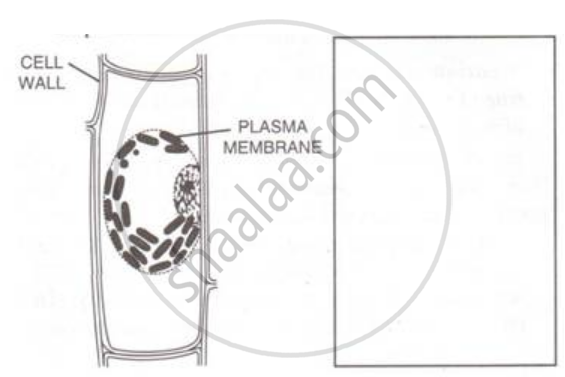
Comment on the nature (tonicity) of the liquid surrounding the cell.
Give Reasons for the following.
On sprinkling common salt on grass growing in a lawn, the grass is killed.
Give Technical Term for the following.
The pressure which is responsible for the movement of water molecules across the cortical cells of the root.
Name the following:
The process by which raisins swell up when placed in a beaker of water.
Multiple Choice Question:
Marine fish when thrown under tap water bursts because of:
