Advertisements
Advertisements
प्रश्न
Given below is an experimental demonstration.
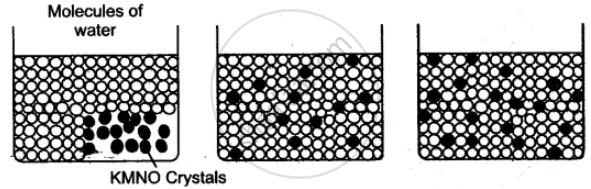
(i) Which phenomenon has been demonstrated in the given figure?
(ii) What is the solute and what is solvent in the above experiment?
(iii) Define the phenomenon in Q. (i) above.
(iv) Give one example from your daily life experiences based on this principle.
Advertisements
उत्तर
(i) Diffusion.
(ii) KMnO4 crystals represent the solute and water is solvent.
(iii) The movement of the molecules of a substance from the region of their higher concentration to the region of their lower concentration until a state of equilibrium is achieved in both the regions.
(iv) If a bottle of scent or spirit is opened in one comer of a closed room, its smell can be felt in every part of the room.
संबंधित प्रश्न
The phenomenon of loss of water through a cut stem or injured part of plant is called ___________.
Differentiate between the following:
Guttation and bleeding
How is root hair adapted for the absorption of water from the soil?
The diagram given below represents a plant cell after being placed in a strong sugar solution. Guidelines 1 to 5 indicate the following:
1. Strong sugar solution
2. Cell wall
3. Protoplasm
4. Large vacuole
5. Nucleus
Study the diagram and answer the questions that follow:
(i) What is the state of the cell shown in the diagram?
(ii) Name the structure which acts as a selectively permeable membrane.
(iii) If the cell had been placed in distilled water instead of strong sugar solution which feature would not have been present?
(iv) If the cell in the diagram possessed chloroplasts where would these be present?
(v) Name any one feature of this plant cell which is not present in animal cells.

Choose the correct answer:
Which tissue makes passage for ascent of sap?
Give Technical Term for the following.
Tissue which transports manufactured food from leaves to other parts of the plant.
Name the following:
Name the process by which intact plants lose water in the form of droplets.
How many regions are there in a typical root?
Root hair is a cytoplasmic extension of ______.
