Advertisements
Advertisements
Question
Given below is an experimental demonstration.
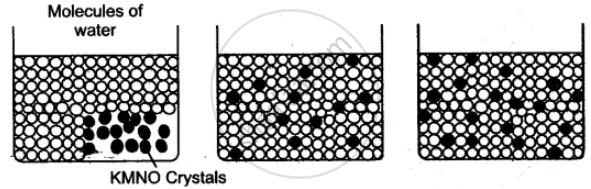
(i) Which phenomenon has been demonstrated in the given figure?
(ii) What is the solute and what is solvent in the above experiment?
(iii) Define the phenomenon in Q. (i) above.
(iv) Give one example from your daily life experiences based on this principle.
Advertisements
Solution
(i) Diffusion.
(ii) KMnO4 crystals represent the solute and water is solvent.
(iii) The movement of the molecules of a substance from the region of their higher concentration to the region of their lower concentration until a state of equilibrium is achieved in both the regions.
(iv) If a bottle of scent or spirit is opened in one comer of a closed room, its smell can be felt in every part of the room.
RELATED QUESTIONS
What are root hair? Mention the function performed by the root hair.
Which one of the following is a characteristic NOT related with the suitability of the roots for absorbing water?
Three plants (a), (b) and (c) were placed in beakers containing coloured water. The water in each beaker was covered with a layer of oil. The leaves were removed from plant (b), while plant (c) was exposed to strong light.
(i) In which plant, (a), (b) or (c) would the water move up the fastest?
(ii) In which plant (a), (b) or (c), would the water move up slowly?
(iii) Why was the water covered with a layer of oil?
(iv) What is being investigated by this experiment?

Choose the correct answer:
Which one is semi-permeable?
The diagram given below represents the result of an experiment conducted on two freshly taken shoots of a green herbaceous plant. The lower ends dip in the water.
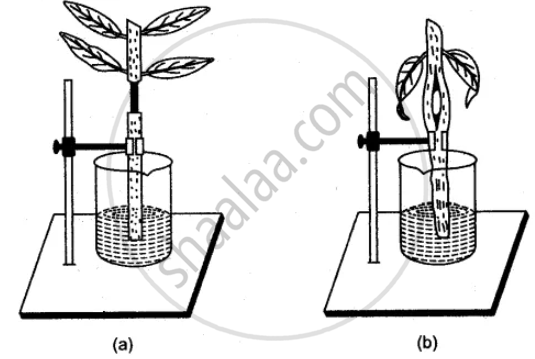
(i) What is the aim of the experiment?
(ii) Some parts of the stem in both the shoots have been removed. Name the conducting tissue in shoot A and in shoot B, that has been removed.
(iii) What are the results of this experiment?
Define: Root hair
What is the composition of an outer layer of root hair?
Epiphytic plants like orchids absorb water vapours from air with the help of ______ having special tissue called velamen.
Which plant does tissue transport water and minerals from the roots to the leaf?
Explain about the factors that affect water absorption.
