Advertisements
Advertisements
प्रश्न
Given below is an experimental demonstration.
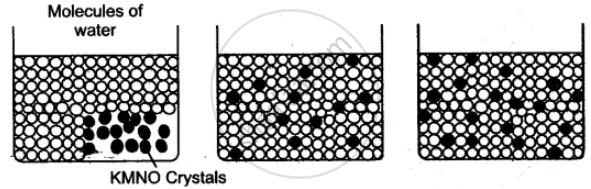
(i) Which phenomenon has been demonstrated in the given figure?
(ii) What is the solute and what is solvent in the above experiment?
(iii) Define the phenomenon in Q. (i) above.
(iv) Give one example from your daily life experiences based on this principle.
Advertisements
उत्तर
(i) Diffusion.
(ii) KMnO4 crystals represent the solute and water is solvent.
(iii) The movement of the molecules of a substance from the region of their higher concentration to the region of their lower concentration until a state of equilibrium is achieved in both the regions.
(iv) If a bottle of scent or spirit is opened in one comer of a closed room, its smell can be felt in every part of the room.
संबंधित प्रश्न
How is root hair adapted for the absorption of water from the soil?
A few RBC’s were kept in three test tubes containing isotonic, hypotonic and hypertonic solutions. What will be the expected observations after a few hours? Explain.
The figure given below is a diagrammatic representation of a part of the cross-section of the root in the root hair zone. Study the same and then answer the questions that follow :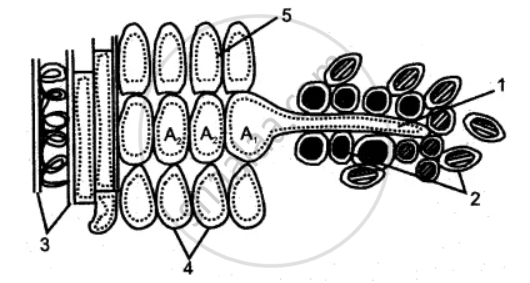
(i) Name the parts indicated by guidelines ‘1’ to ‘5’
(ii) Is the root hair cell unicellular or multi-cellular?
(iii) Draw a labeled diagram of the root hair cell as it would appear if some fertilizer is added to the soil close to it.
(iv) Name the process responsible for the entry of water molecules from the soil into A1 and then A2.
(v) What pressure is responsible for the movement of water in the direction indicated by arrows?
(vi) How is this pressure set up?
A thin strip of epidermal cells from the fleshy scales of an onion bulb was examined in a drop of water, under a microscope. All the epidermal cells looked alike and the figure alongside represents one of them. The thin strip was then transferred to a drop of strong sugar solution and re-examined under the microscope after about five minutes.

(i) Make a sketch of one of the epidermal cells, as it might appear after immersion in a strong sugar solution. Label any two parts which have undergone a change.
(ii) Give the scientific term for the change shown in Q.(i) above.
(iii) What would you do to bring this cell back to its original condition?
(iv) Give the scientific term used for the recovery of the cell as a result of the step taken in Q.(iii) above.
________ type of tissues are present in epiphytic roots.
Root hair is ________ extension of epiblema cells.
Draw a neat and labelled diagram of the Root tip showing the root hair zone.
Part of the root that absorbs water from the soil is ______.
Epiphytic plants like orchids absorb water vapours from air with the help of epiphytic roots having special tissue called ____________.
Look at Figure. Draw another figure of the same set-up as would be observed after a few hours.

