Advertisements
Advertisements
Question
Three plants (a), (b) and (c) were placed in beakers containing coloured water. The water in each beaker was covered with a layer of oil. The leaves were removed from plant (b), while plant (c) was exposed to strong light.
(i) In which plant, (a), (b) or (c) would the water move up the fastest?
(ii) In which plant (a), (b) or (c), would the water move up slowly?
(iii) Why was the water covered with a layer of oil?
(iv) What is being investigated by this experiment?

Advertisements
Solution
(i) In (c), the water would move up the fastest.
(ii) In (b), the water would move up slowly.
(iii) To prevent evaporation of water.
(iv) Absorption of water by the roots.
APPEARS IN
RELATED QUESTIONS
Multiple Choice Question:
Put a tick mark (✓) against the correct alternative in the following statement:
The root-hairs are suited for absorbing water from the soil because:
State whether the following statement is true or false. Rewrite the false statement correctly.
Water absorption mainly occurs through the root-hair.
Study the experimental setup in the figure and then answer the question that follow.
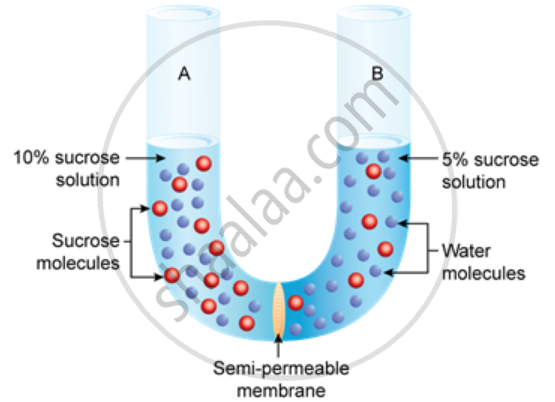
Explain the phenomenon mention in question 8.1 .
The alongside diagram A shows a root hair growing through the soil particles. Diagram B is the root hair of an aquatic plant.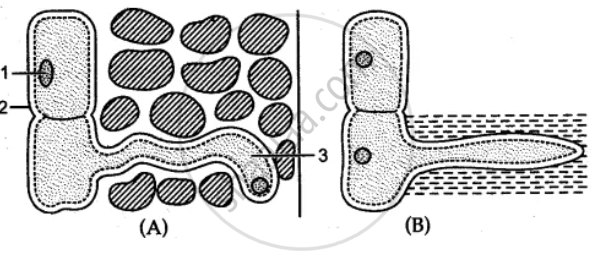
(i) Name the parts 1,2,3.
(ii) Name two substances which enter the root hair. What are their uses?
(iii) By what process do these substances enter the root hair?
(iv) Account for the different shapes of root hairs in the two diagrams.
The below figure shows a root hair: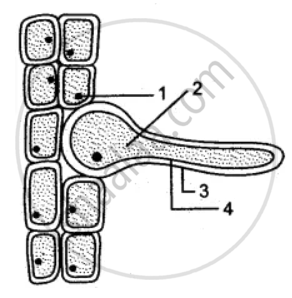
(i) Label the parts 1 to 4.
(ii) What is the role of part 4?
(iii) Why is the root hair one-celled?
(iv) What will happen to the root hair if some fertilizer is added to the soil near the root hair?
Describe structure of root hair.
Epiphytic plants like orchids absorb water vapours from air with the help of ______ having special tissue called velamen.
Identify the part of the plants which is responsible for maximum absorption of water.
Water in the root enters due to ______.
