Advertisements
Advertisements
प्रश्न
Three plants (a), (b) and (c) were placed in beakers containing coloured water. The water in each beaker was covered with a layer of oil. The leaves were removed from plant (b), while plant (c) was exposed to strong light.
(i) In which plant, (a), (b) or (c) would the water move up the fastest?
(ii) In which plant (a), (b) or (c), would the water move up slowly?
(iii) Why was the water covered with a layer of oil?
(iv) What is being investigated by this experiment?

Advertisements
उत्तर
(i) In (c), the water would move up the fastest.
(ii) In (b), the water would move up slowly.
(iii) To prevent evaporation of water.
(iv) Absorption of water by the roots.
APPEARS IN
संबंधित प्रश्न
What are root hair? Mention the function performed by the root hair.
How is root hair adapted for the absorption of water from the soil?
What part is played by the following in the uptake of water into the root hair?
The cell wall
What part is played by The cytoplasm in the uptake of water into the root hair?
Root hairs become flaccid, when fertilizers are added to the moist soil around it. Explain.
The diagram given below represents the result of an experiment conducted on two freshly taken shoots of a green herbaceous plant. The lower ends dip in the water.
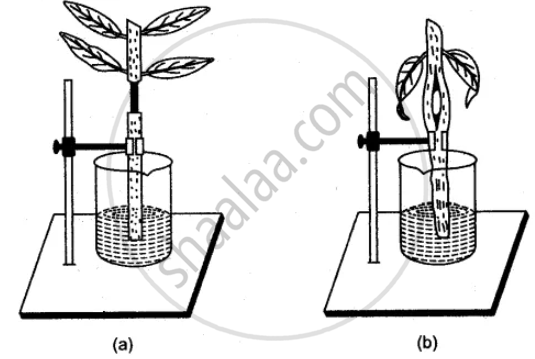
(i) What is the aim of the experiment?
(ii) Some parts of the stem in both the shoots have been removed. Name the conducting tissue in shoot A and in shoot B, that has been removed.
(iii) What are the results of this experiment?
Root hairs are ______
Roots of the plants absorb water from the soil through the process of ____________.
Water in the root enters due to ______.
