Advertisements
Advertisements
प्रश्न
Explain the mechanism of closing and opening of the stomata.
Advertisements
उत्तर
The closing and opening of the stomata depends on the turgidity of the guard cells. Each guard
cell has a thicker wall on the side facing the stoma and a thin wall on the opposite side. Guard cells contain chloroplasts. As a result of the synthesis of glucose during photosynthesis and some other chemical changes, the osmotic pressure of the contents of the guard cells increases and they absorb more water from the neighbouring cells, thus becoming turgid. Due to turgor, the guard cells become more arched outwards and the aperture between them widens, thereby opening the stoma.

At night or when there is shortage of water in the leaf, the guard cells turn flaccid and their inner rigid walls become straight, thus closing the stomatal aperture.
संबंधित प्रश्न
How does movement and absorption of water take place through the roots?
Choose the correct answer:
Which one is semi-permeable?
Choose the correct answer:
Exudation or bleeding is associated with ___________
The diagram below represents a layer of epidermal cells showing a fully grown root hair. Study the diagram and answer the questions that follow:

Mention one distinct difference between the parts labelled A and B.
Study the experimental setup in the figure and then answer the question that follow.
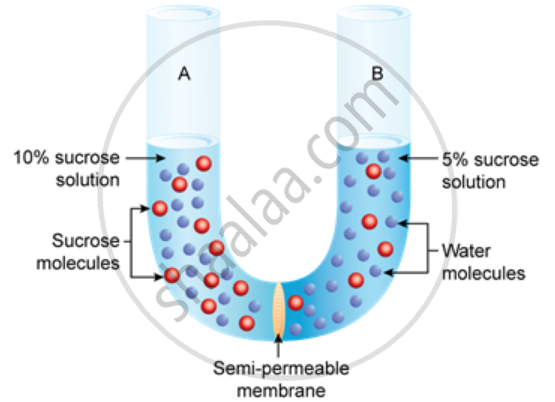
Explain the phenomenon mention in question 8.1 .
Give Technical Term for the following.
Phenomenon of absorption of water by surface attraction.
Which part of the root helps in the maximum absorption of water and minerals?
The tubular, colorless delicate prolongations of epidennal cells are seen in which region of root in plants?
