Advertisements
Advertisements
प्रश्न
Three plants (a), (b) and (c) were placed in beakers containing coloured water. The water in each beaker was covered with a layer of oil. The leaves were removed from plant (b), while plant (c) was exposed to strong light.
(i) In which plant, (a), (b) or (c) would the water move up the fastest?
(ii) In which plant (a), (b) or (c), would the water move up slowly?
(iii) Why was the water covered with a layer of oil?
(iv) What is being investigated by this experiment?

Advertisements
उत्तर
(i) In (c), the water would move up the fastest.
(ii) In (b), the water would move up slowly.
(iii) To prevent evaporation of water.
(iv) Absorption of water by the roots.
APPEARS IN
संबंधित प्रश्न
Choose the correct answer:
Meaning of ascent of sap is ____________
Choose the correct answer:
Exudation or bleeding is associated with ___________
Draw a cross-section of root showing association of soil particles with root hairs.
Draw a diagram of the root hair cell as it would appear when a concentrated solution of fertilizers is added near it.
The figure given below is a diagrammatic representation of a part of the cross-section of the root in the root hair zone. Study the same and then answer the questions that follow :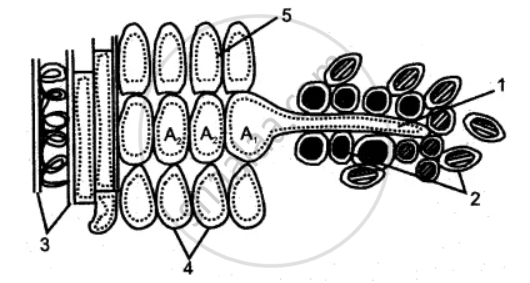
(i) Name the parts indicated by guidelines ‘1’ to ‘5’
(ii) Is the root hair cell unicellular or multi-cellular?
(iii) Draw a labeled diagram of the root hair cell as it would appear if some fertilizer is added to the soil close to it.
(iv) Name the process responsible for the entry of water molecules from the soil into A1 and then A2.
(v) What pressure is responsible for the movement of water in the direction indicated by arrows?
(vi) How is this pressure set up?
Multiple Choice Question:
The most widely accepted theory for ascent of sap is ______.
Water which is absorbed by roots is transported to aerial parts of the plant through ______
Part of the root that absorbs water from the soil is ______.
____________ regions are present in a typical root.
Roots of the plants absorb water from the soil through the process of ____________.
