Advertisements
Advertisements
प्रश्न
The apparatus arranged alongside signifies an important process.
(i) Name the process.
(ii) Where does this process occur in plants?
(iii) What solution is placed inside the dialysis tubing?
(iv) What happens to the level of the solution in the capillary tube?

Advertisements
उत्तर
(i) Osmosis
(ii) Root hair
(iii) Sugar solution
(iv) The level of the liquid in the capillary tube rises.
APPEARS IN
संबंधित प्रश्न
Differentiate between the following:
Guttation and bleeding
Study the experimental setup in the figure and then answer the question that follow.
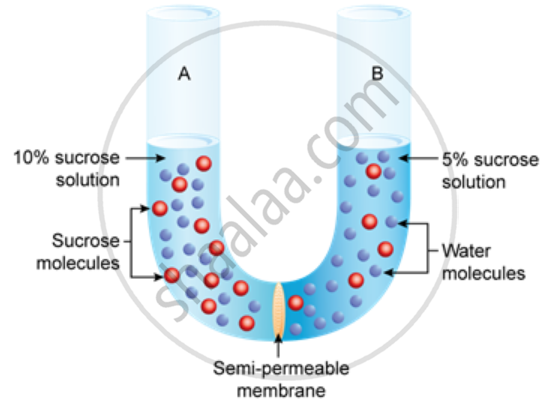
What will you observe in the setup after about half an hour? Give reasons for your answer.
The figure given below is a diagrammatic representation of a part of the cross-section of the root in the root hair zone. Study the same and then answer the questions that follow :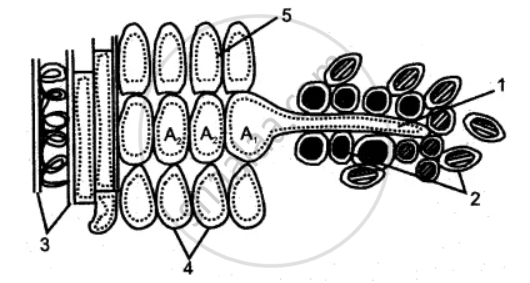
(i) Name the parts indicated by guidelines ‘1’ to ‘5’
(ii) Is the root hair cell unicellular or multi-cellular?
(iii) Draw a labeled diagram of the root hair cell as it would appear if some fertilizer is added to the soil close to it.
(iv) Name the process responsible for the entry of water molecules from the soil into A1 and then A2.
(v) What pressure is responsible for the movement of water in the direction indicated by arrows?
(vi) How is this pressure set up?
A thin strip of epidermal cells from the fleshy scales of an onion bulb was examined in a drop of water, under a microscope. All the epidermal cells looked alike and the figure alongside represents one of them. The thin strip was then transferred to a drop of strong sugar solution and re-examined under the microscope after about five minutes.

(i) Make a sketch of one of the epidermal cells, as it might appear after immersion in a strong sugar solution. Label any two parts which have undergone a change.
(ii) Give the scientific term for the change shown in Q.(i) above.
(iii) What would you do to bring this cell back to its original condition?
(iv) Give the scientific term used for the recovery of the cell as a result of the step taken in Q.(iii) above.
Name the following:
The kind of cells that constitute the cortex of a root.
________ type of tissues are present in epiphytic roots.
Write a note on the morphological structure of the root.
They are pipe-like, consisting of a group of specialised cells. They transport substances and form two-way traffic in plants. Which of the following terms qualify for the features mentioned above?
What is peculiarity of epiphytic plants like orchids?
Explain about the factors that affect water absorption.
