Advertisements
Advertisements
प्रश्न
The apparatus arranged alongside signifies an important process.
(i) Name the process.
(ii) Where does this process occur in plants?
(iii) What solution is placed inside the dialysis tubing?
(iv) What happens to the level of the solution in the capillary tube?

Advertisements
उत्तर
(i) Osmosis
(ii) Root hair
(iii) Sugar solution
(iv) The level of the liquid in the capillary tube rises.
APPEARS IN
संबंधित प्रश्न
The phenomenon of loss of water through a cut stem or injured part of plant is called ___________.
What are root hair? Mention the function performed by the root hair.
Mention whether the following statement is true (T) or false (F) and give explanation in support of your answer.
Dry seeds when submerged in water swell up due to endosmosis.
Study the experimental setup in the figure and then answer the question that follow.
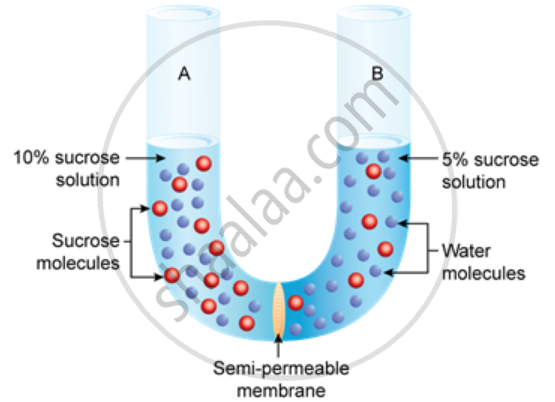
Explain the phenomenon mention in question 8.1 .
Differentiate between the following
Permeable and Semi-permeable membrane.
The below figure shows a root hair: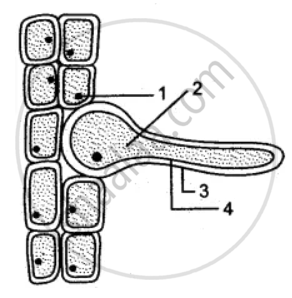
(i) Label the parts 1 to 4.
(ii) What is the role of part 4?
(iii) Why is the root hair one-celled?
(iv) What will happen to the root hair if some fertilizer is added to the soil near the root hair?
Part of the root that absorbs water from the soil is ______.
Trace the pathway followed by water molecules from the time it enters a plant root to the time it escapes into the atmosphere from a leaf.
Epiphytic plants like orchids absorb water vapours from air with the help of ______ having special tissue called velamen.
Root hair occurs in the zone of ____________.
