Advertisements
Advertisements
प्रश्न
Advertisements
उत्तर
(i) The epidermis and endodermis of root hairs are permeable to water.
(ii) Root hairs have a very large surface area.
APPEARS IN
संबंधित प्रश्न
Name the following:
The process by which water enters root hairs.
Mention whether the following statement is true or false. Correct the false statement by altering the last word only.
Xylem is the water conducting tissue in plants.
The diagram given below represents the results of an experiment conducted on two freshly taken leafy shoots of a herbaceous plant. The lower ends of the shoots dip in ordinary water.
(i) What is the aim of the experiment?
(ii) Some parts of the stem in both the shoots have been removed. Name the conducting tissue in shoot (a) and in shoot (b) that has been removed.
(iii) What are the results of this experiment?

Choose the correct answer:
Meaning of ascent of sap is ____________
How is root hair structurally adapted for absorption of water from the soil?
The below figure shows a root hair: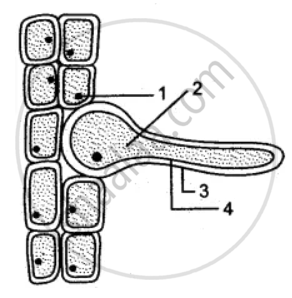
(i) Label the parts 1 to 4.
(ii) What is the role of part 4?
(iii) Why is the root hair one-celled?
(iv) What will happen to the root hair if some fertilizer is added to the soil near the root hair?
What is the composition of inner layer of root hair?
Part of the root that absorbs water from the soil is ______.
Which of the following are the components of cell wall of root hair?
Explain about the factors that affect water absorption.
