Advertisements
Advertisements
प्रश्न
The diagram given below represents the results of an experiment conducted on two freshly taken leafy shoots of a herbaceous plant. The lower ends of the shoots dip in ordinary water.
(i) What is the aim of the experiment?
(ii) Some parts of the stem in both the shoots have been removed. Name the conducting tissue in shoot (a) and in shoot (b) that has been removed.
(iii) What are the results of this experiment?

Advertisements
उत्तर
(i) The aim of the experiment is to show that conduction of water in plants takes place through xylem.
(ii) In shoot, (a) phloem has been removed. In shoot (b), xylem has been removed.
(iii) In shoot (b), xylem has been removed so the leaves are wilted. But in shoot (a), xylem has not been removed so the leaves are turgid.
APPEARS IN
संबंधित प्रश्न
How does movement and absorption of water take place through the roots?
Given below is the diagrammatic representation of the transverse section of a part of a plant. Study it and answer the questions that follow:
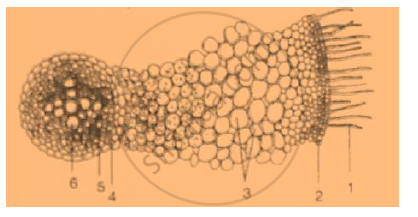
(a) Name the part of the plant that is shown
(b) Label the parts 1 to 6
(c) Write the functions of parts 3 and 5
Choose the correct answer:
Absorption of water from soil takes place by __________
The diagram below represents a layer of epidermal cells showing a fully grown root hair. Study the diagram and answer the questions that follow:

Draw a diagram of the above root hair cell as it would appear when a concentrated solution of fertilizers is added near it.
Given below is the diagram of a cell as seen under the microscope after having been placed in a solution:

(i) What is the technical term used for the state/condition of the cell given above?
(ii) Give the technical term for the solution in which the cell was placed.
(iii) Name the parts numbered 1 to 4.
(iv) Is the cell given above a plant cell or an animal cell ? Give two reasons in support of your answer as evident from the diagram.
(v) What would you do to bring this cell back to its original condition?
Name the following:
The solution outside the cell having lower solute concentration than the fluids.
Draw a neat and labelled diagram of the Root tip showing the root hair zone.
Epiphytic plants like ____________ absorb water vapours from air with the help of epiphytic roots having special tissue called velamen.
Epiphytic plants like orchids absorb water vapours from air with the help of ______ having special tissue called velamen.
Look at Figure. Draw another figure of the same set-up as would be observed after a few hours.

