Advertisements
Advertisements
प्रश्न
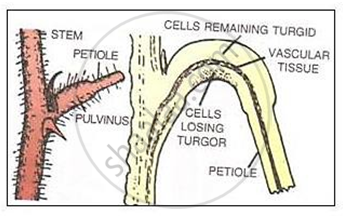
Leaves of the sensitive plant wilt and droop down on a slight touch. What mechanism brings about this change?
Advertisements
उत्तर
Leaves of the sensitive plant wilt and droop down on a slight touch due to turgor movement. Petiole of sensitive plant is held up by turgid pulvinus tissue. The stimulus of touch leads to loss of turgor at the base of the leaflets and at the base of the petioles i.e. pulvinus. The cells of the lower side of pulvinus lose water and the petiole collapses. This causes the wilting and drooping of the leaves
संबंधित प्रश्न
Differentiate between the following on the basis of what is indicated in the bracket.
Hypotonic solution and Hypertonic solution (condition of a plant cell when placed in them).
The most appropriate characteristic of a semipermeable membrane is that
(a) Mention whether the following statement is true (True) or false (False)
(b) Correct the false statement by altering the last word only.
A plant cell placed in hypotonic solution gets Plasmolysed.
Give Reasons for the following.
We gargle with saline water in case of throat infection.
Give Reasons for the following.
Plants begin to die when the excess of soluble fertilizers are added to the soil?
Name the following:
Name the process by which water enters the root hair cell.
Mention, if the following statement is True or False. If false rewrite the wrong statement in its correct form:
Osmosis is defined as the movement of water from a concentrated sugar solution to a dilute sugar solution.
Mention, if the following statement is True or False. If false rewrite the wrong statement in its correct form:
Cells that have lost their water content are said to be deplasmolysed.
