Advertisements
Advertisements
Question
A candidate in order to study the process of osmosis has taken 3 potato cubes and put them in 3 different beakers containing 3 different solutions. After 24 hours, in the first beaker the potato cube increased in size, in the second beaker the potato cube decreased in size and in the third beaker there was no change in the size of the potato cube. The following diagram shows the result of the same experiment:

(i) Give the technical terms of the solutions used in beakers, 1, 2 and 3.
(ii) In beaker 3, the size of the potato cube remains the same. Explain the reason in brief.
(iii) Write the specific feature of the cell sap of root hairs which helps in absorption of water.
(iv) What is osmosis?
(v) How does a cell wall and a cell membrane differ in their permeability?
Advertisements
Solution
(i)
Solution 1 – Hypotonic solution
Solution 2 – Hypertonic solution
Solution 3 – Isotonic solution
(ii) In beaker three, the solution present is an isotonic solution, i.e. the relative concentration of water molecules and solutes is same in the solution as well as inside the cell. There is no movement of water molecules across the cell membrane. Hence, the size of the potato cubes remains same.
(iii) The cell sap of root hairs has higher concentration of solute than the surrounding water.
(iv) Osmosis is the diffusion of water molecules across the semi-permeable membrane from the region of dilute solution (i.e. a lower solute concentration) to the region of concentrated solution (i.e. a higher solute concentration).
(v) The cell wall is freely permeable to all the substances, while the cell membrane is selectively permeable and allows only certain substances to enter or exit the cell.
APPEARS IN
RELATED QUESTIONS
Osmosis and diffusion are the same except that osmosis there is:
The most appropriate characteristic of a semipermeable membrane is that
Complete the following statements:
Hypotonic solution is one in which the solution kept outside the cell has lower solute concentration than ……………… the cell.
Leaves of the sensitive plant wilt and droop down on a slight touch. What mechanism brings about this change?
The diagram given below represents an experimental set-up to demonstrate a certain process. Study the same and answer the questions that follow:
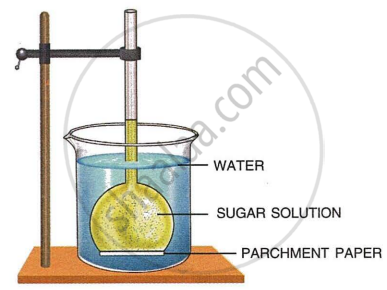
- Name the process.
- Define the above-named process.
- What would you observe in the experimental set-up after an hour or so?
- What control experiment can be set up for comparison?
- Keeping in mind the root hair, cell and its surroundings, name the parts that correspond to
- concentrated sugar solution
- parchment paper
- water in the beaker
- Name any other material that can be used instead of parchment paper in the above experiment.
- Mention two advantages of the process for the plants.
Choose the correct answer:
If a marine plant is transferred to fresh water, it bursts due to ___________
What do you mean by transpiration pull ?
Give Reasons for the following.
The raisins swell up in the water.
Give Reasons for the following.
Plants growing in fertilized soil are often found to wilt if the soil is not adequately watered. Why?
Fill in the Blank
Raisin swells up when kept in a __________ solution.
