Advertisements
Advertisements
प्रश्न
A candidate in order to study the process of osmosis has taken 3 potato cubes and put them in 3 different beakers containing 3 different solutions. After 24 hours, in the first beaker the potato cube increased in size, in the second beaker the potato cube decreased in size and in the third beaker there was no change in the size of the potato cube. The following diagram shows the result of the same experiment:

(i) Give the technical terms of the solutions used in beakers, 1, 2 and 3.
(ii) In beaker 3, the size of the potato cube remains the same. Explain the reason in brief.
(iii) Write the specific feature of the cell sap of root hairs which helps in absorption of water.
(iv) What is osmosis?
(v) How does a cell wall and a cell membrane differ in their permeability?
Advertisements
उत्तर
(i)
Solution 1 – Hypotonic solution
Solution 2 – Hypertonic solution
Solution 3 – Isotonic solution
(ii) In beaker three, the solution present is an isotonic solution, i.e. the relative concentration of water molecules and solutes is same in the solution as well as inside the cell. There is no movement of water molecules across the cell membrane. Hence, the size of the potato cubes remains same.
(iii) The cell sap of root hairs has higher concentration of solute than the surrounding water.
(iv) Osmosis is the diffusion of water molecules across the semi-permeable membrane from the region of dilute solution (i.e. a lower solute concentration) to the region of concentrated solution (i.e. a higher solute concentration).
(v) The cell wall is freely permeable to all the substances, while the cell membrane is selectively permeable and allows only certain substances to enter or exit the cell.
संबंधित प्रश्न
Osmosis and diffusion are the same except that osmosis there is:
Complete the following statements:
Hypotonic solution is one in which the solution kept outside the cell has lower solute concentration than ……………… the cell.
When placed in a more concentrated solution, the cell contents will ______.
Explain why:
We gargle with saline solution in case of throat infection.
The diagram given below is of an experiment just at the start. Study the diagram carefully and answer the following questions :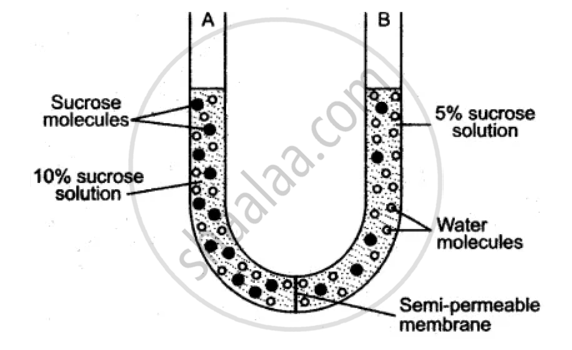
(i) What does the experiment demonstrate?
(ii) Define, the process demonstrated in the experiment.
(iii) What changes are observed after a few hours?
(iv) Give two examples of a semi-permeable membrane.
(v) Which limb of the U-tube contains a more concentrated sucrose solution, A or B?
(vi) Why is the membrane separating the two solutions labeled as semi-permeable membrane?
Give Technical Term for the following.
A solution whose concentration is greater than that of the cell sap.
Mention, if the following statement is True or False. If false rewrite the wrong statement in its correct form:
During exosmosis, water moves from inside the cell to the outside of the cell.
Fill in the Blank
A plasmolysed cell has __________ protoplast.
Mention, if the following statement is True or False. If false rewrite the wrong statement in its correct form:
Plasmolysis makes the cell turgid.
