Advertisements
Advertisements
Question
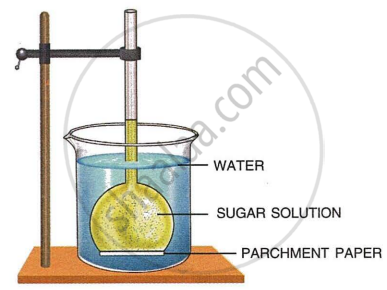
The diagram below represents an experimental set up to demonstrate a vital process. Study the same and then answer the questions that follow:
(i) Name the process.
(ii) Define the above named process.
(iii) What would you observe in the experimental setup after an hour or so?
(iv) What control experiment can be set up for the above experiment?
(v) Keeping in mind the root hair cell and its surrounding name the part that corresponds to (1) Concentrated sugar solution, (2) Parchment paper, (3) Water in the beaker.
(vi) Name any other substance that can be used instead of parchment paper in the above experiment.
(vii) Mention two advantages of this process to the plant.
Advertisements
Solution
(i) Osmosis.
(ii) Transfer of water or solvent molecules from a solution of lower concentration to a solution of higher concentration through a semi-permeable membrane is called osmosis.
(iii) The level of sugar solution rises in the stem of thistle funnel, whereas the water level in the beaker falls.
(iv) A non-permeable membrane can be used in place of parchment paper for a control experiment.
(v) (1) Root hair cell sap corresponds to concentrated sugar solution.
(2) Cell membrane of root hair cell corresponds to parchment paper.
(3) Soil solution corresponds to water in the beaker.
(vi) Goat’s bladder or pig’s bladder.
(vii) (1) Helps in water absorption.
(2) Helps in stomatal opening and closing thus facilitating gaseous exchange.
RELATED QUESTIONS
Give two examples of turgor movements in plants.
The diagram given below represents an experimental set-up to demonstrate a certain process. Study the same and answer the questions that follow:
- Name the process.
- Define the above-named process.
- What would you observe in the experimental set-up after an hour or so?
- What control experiment can be set up for comparison?
- Keeping in mind the root hair, cell and its surroundings, name the parts that correspond to
- concentrated sugar solution
- parchment paper
- water in the beaker
- Name any other material that can be used instead of parchment paper in the above experiment.
- Mention two advantages of the process for the plants.
Explain why:
The leaves of wilted lettuce, if kept in cold water, become crisp.
Give at least three uses of water to green plants
Give Reasons for the following.
Freshwater fish cannot survive in seawater.
The apparatus arranged here signifies an important process.
(i) Name the process.
(ii) Where does this process occur in plants?
(iii) What solution is placed inside the dialysis tubing?
(iv) What happens to the level of the solution in the capillary tube?
(v) Define the process mentioned in Q. (i) above.
Given below is the figure of an experimental set up to demonstrate root pressure.
(i) Define root pressure.
(ii) What change would you observe in the water level after some time?
(iii) What role is being played by the root pressure in the given experiment?
(iv) Why the oil has been sprinkled on water?
Mention, if the following statement is True or False. If false rewrite the wrong statement in its correct form:
Osmosis is defined as the movement of water from a concentrated sugar solution to a dilute sugar solution.
Mention, if the following statement is True or False. If false rewrite the wrong statement in its correct form:
Plasmolysis makes the cell turgid.
Multiple Choice Question:
When a plant wilts, the sequence of events will be as follows:
