Advertisements
Advertisements
Question
Explain the term:
Plasmolysis
Advertisements
Solution
- When a living cell is placed in a hypertonic solution, exo-osmosis occurs. This is called plasmolysis.
- During plasmolysis, the protoplast of the cell shrinks and recedes from the cell wall, causing the cell to become flaccid. Such a cell is called a plasmolysed cell.
- In a plasmolyzed cell, a gap is developed between the cell wall and the protoplast. This gap is filled by the outer solution.
APPEARS IN
RELATED QUESTIONS
Differentiate between Diffusion and Osmosis (Definition)
A plant cell placed in a certain solution got plasmolysed. What was the kind of solution?
The highest water potential (capacity to move out higher concentrated solution) is that of ______.
The space between the cell wall and plasma membrane in a plasmolysed cell is filled with ______.
Give the equivalent terms for the following:
Pressure of the cell contents on the cell wall
Mention whether the following statement is true or false. Correct the false statement by altering the last word only.
Addition of salt to pickles prevents growth of bacteria because they turn turgid.
Leaves of the sensitive plant wilt and droop down on a slight touch. What mechanism brings about this change?
Show by a series of diagrams, the change which a plant cell will undergo when placed in
Hypertonic salt solution
Define the following:
Osmosis
Distinguish between the following:
Turgor pressure and osmotic pressure
Name the following:
The inward movement of solvent molecules through the plasma membrane of the cell.
Differentiate between the following
Endosmosis and Exosmosis
The diagram given below is of an experiment just at the start. Study the diagram carefully and answer the following questions :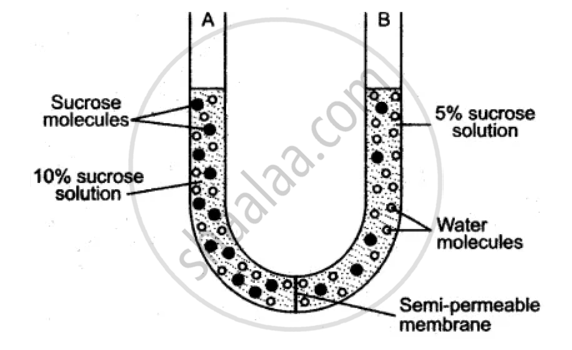
(i) What does the experiment demonstrate?
(ii) Define, the process demonstrated in the experiment.
(iii) What changes are observed after a few hours?
(iv) Give two examples of a semi-permeable membrane.
(v) Which limb of the U-tube contains a more concentrated sucrose solution, A or B?
(vi) Why is the membrane separating the two solutions labeled as semi-permeable membrane?
The diagram below represents an experimental set up to demonstrate a vital process. Study the same and then answer the questions that follow:
(i) Name the process.
(ii) Define the above named process.
(iii) What would you observe in the experimental setup after an hour or so?
(iv) What control experiment can be set up for the above experiment?
(v) Keeping in mind the root hair cell and its surrounding name the part that corresponds to (1) Concentrated sugar solution, (2) Parchment paper, (3) Water in the beaker.
(vi) Name any other substance that can be used instead of parchment paper in the above experiment.
(vii) Mention two advantages of this process to the plant.
Give Technical Term for the following.
A solution whose concentration is equal to the cell sap.
Give Technical Term for the following.
The condition in which the water from a cell is completely removed due to exosmosis and no more shrinkage is possible.
Define the following term:
Osmotic Pressure
