Advertisements
Advertisements
प्रश्न
Explain the term:
Plasmolysis
Advertisements
उत्तर
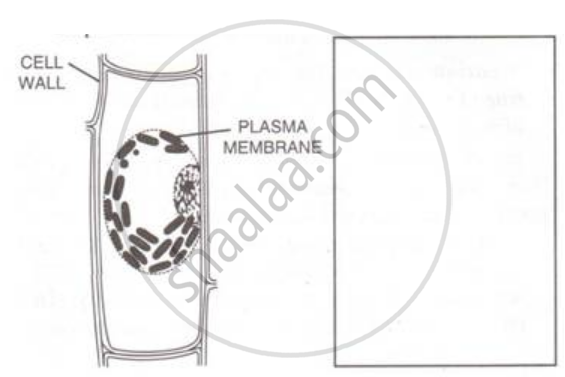
- When a living cell is placed in a hypertonic solution, exo-osmosis occurs. This is called plasmolysis.
- During plasmolysis, the protoplast of the cell shrinks and recedes from the cell wall, causing the cell to become flaccid. Such a cell is called a plasmolysed cell.
- In a plasmolyzed cell, a gap is developed between the cell wall and the protoplast. This gap is filled by the outer solution.
APPEARS IN
संबंधित प्रश्न
Differentiate between Diffusion and Osmosis (Definition)
A candidate in order to study the process of osmosis has taken 3 potato cubes and put them in 3 different beakers containing 3 different solutions. After 24 hours, in the first beaker the potato cube increased in size, in the second beaker the potato cube decreased in size and in the third beaker there was no change in the size of the potato cube. The following diagram shows the result of the same experiment:

(i) Give the technical terms of the solutions used in beakers, 1, 2 and 3.
(ii) In beaker 3, the size of the potato cube remains the same. Explain the reason in brief.
(iii) Write the specific feature of the cell sap of root hairs which helps in absorption of water.
(iv) What is osmosis?
(v) How does a cell wall and a cell membrane differ in their permeability?
Give the appropriate biological or technical term for the following.
Movement of molecules of a substance from their higher concentration to lower concentration when they are in direct contact.
Define the following:
Diffusion
Distinguish between the following:
Filtration and diffusion
Choose the correct answer:
Osmosis involves diffusion of ___________
Choose the correct answer:
Cell turgidity is caused by _______________
Two potato cubes each 1 cm3 in size, were placed separately in two containers (A and B), the container A having water and the other (B) containing concentrated sugar solution. After 24 hours when the cubes were examined, those placed in water were found to be firm and had increased slightly in size and those placed in concentrated sugar solution were found to be soft and somewhat decreased in size. Use the above information to answer the questions that follow:
Account for the softness and decrease in size of the potato cubes which were placed in sugar solution.
A leaf cell of a water plant was placed in a liquid other than pond water. After sometime, it assumed a shape as shown below:
Comment on the nature (tonicity) of the liquid surrounding the cell.
Give Reasons for the following.
Plants begin to die when the excess of soluble fertilizers are added to the soil?
Give Technical Term for the following.
Solutions which have the same osmotic pressure.
Give Technical Term for the following.
The condition in which the water from a cell is completely removed due to exosmosis and no more shrinkage is possible.
Mention, if the following statement is True or False. If false rewrite the wrong statement in its correct form:
Osmosis is defined as the movement of water from a concentrated sugar solution to a dilute sugar solution.
Mention, if the following statement is True or False. If false rewrite the wrong statement in its correct form:
Plasmolysis makes the cell turgid.
Multiple Choice Question:
In the process of osmosis in a cell:
Multiple Choice Question:
When a plant wilts, the sequence of events will be as follows:
Explain the Term:
Osmosis
