Advertisements
Advertisements
प्रश्न
During a practical exam, a plant cell in a particular solution was placed under a compound microscope. Students were told to observe the cell and name the tonicity of the solution and mention the process that occurred in the cell.
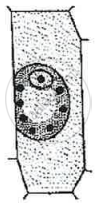
पर्याय
Isotonic, Endosmosis
Hypotonic, Active Transport
Hypertonic, Endosmosis
Hypertonic, Exosmosis
Advertisements
उत्तर
Hypertonic, Exosmosis
APPEARS IN
संबंधित प्रश्न
Differentiate between Diffusion and Osmosis (Definition)
A candidate in order to study the process of osmosis has taken 3 potato cubes and put them in 3 different beakers containing 3 different solutions. After 24 hours, in the first beaker the potato cube increased in size, in the second beaker the potato cube decreased in size and in the third beaker there was no change in the size of the potato cube. The following diagram shows the result of the same experiment:

(i) Give the technical terms of the solutions used in beakers, 1, 2 and 3.
(ii) In beaker 3, the size of the potato cube remains the same. Explain the reason in brief.
(iii) Write the specific feature of the cell sap of root hairs which helps in absorption of water.
(iv) What is osmosis?
(v) How does a cell wall and a cell membrane differ in their permeability?
Give the appropriate biological or technical term for the following.
Movement of molecules of a substance from their higher concentration to lower concentration when they are in direct contact.
Name the following:
The condition of a cell placed in a hypotonic solution.
Complete the following statements:
Hypotonic solution is one in which the solution kept outside the cell has lower solute concentration than ……………… the cell.
Show by a series of diagrams, the change which a plant cell will undergo when placed in
Hypotonic salt solution
Define the term:
Plasmolysis
Distinguish between the following:
Plasmolysis and deplasmolysis
Give Technical Term for the following.
Solutions which have the same osmotic pressure.
Give Technical Term for the following.
The pressure which is responsible for the movement of water molecules across the cortical cells of the root.
