Advertisements
Advertisements
Question
Explain the term:
Diffusion
Advertisements
Solution
- Diffusion means to disperse.
- Diffusion can be defined as the movement of ions/ atoms/ molecules of a substance from the region of their higher concentration to the region of their lower concentration till equilibrium is reached.
- The movement is due to the kinetic energy of the molecules.
- Water passes into the cell by diffusion through a freely permeable cell wall.
APPEARS IN
RELATED QUESTIONS
A plant cell placed in a certain solution got plasmolysed. What was the kind of solution?
When placed in a more concentrated solution, the cell contents will ______.
Give two examples of turgor movements in plants.
Define the following:
Diffusion
Distinguish between the following:
Turgor pressure and osmotic pressure
Choose the correct answer:
Grapes when placed in a strong sugar solution shrink because of __________
Give Reasons for the following.
The raisins swell up in the water.
Give Reasons for the following.
Freshwater fish cannot survive in seawater.
Differentiate between:
Osmosis and Diffusion
Give a diagrammatic representation of plasmolysis in a cell.
In an experiment, two sets of apparatus were set up as shown below:
In A there is a concentrated sugar solution inside the thistle funnel and red ink in the water outside the funnel. In B there is a concentrated glucose solution with red ink inside the thistle funnel and water outside the thistle funnel.
In both A and B the level of liquid inside the funnels rises up the tubes. In A the sugar solution turns red and in B, the water turns red.
Study the given observations and answer these questions:

- Name the process by which red ink moves in A and B.
- Which type of pressure forces the water molecules to move towards thistle funnels and cause a rise in the water level?
- Where does this process occur in plants and animals?
- What material could be used as a semi-permeable membrane?
The beaker is divided into two chambers A and B. The big circle represents solute and the small circles solvent.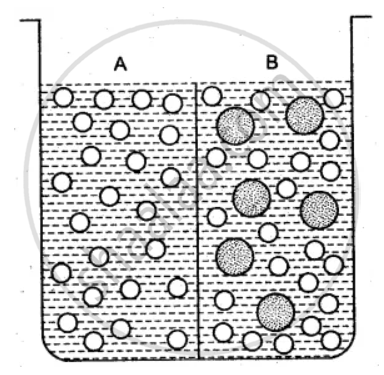
(i) What can you say about the size of the holes in the membrane, if it is to behave semi- permeably between these two?
(ii) Will the solvent molecules pass through the membrane from left to right, from right to left, in either direction or in both directions?
(iii) In which direction will there be a net movement of solvent molecules?
Give Technical Term for the following.
The pressure which is responsible for the movement of water molecules across the cortical cells of the root.
Fill in the Blank
The pressure which develops in the cortical cells of root which force a part of the water upward ____________.
Mention, if the following statement is True or False. If false rewrite the wrong statement in its correct form:
During exosmosis, water moves from inside the cell to the outside of the cell.
Fill in the Blank
A plasmolysed cell has __________ protoplast.
Mention, if the following statement is True or False. If false rewrite the wrong statement in its correct form:
The plasma membrane permits the passage of all solutes and water.
Mention, if the following statement is True or False. If false rewrite the wrong statement in its correct form:
Cells that have lost their water content are said to be deplasmolysed.
Explain the Term: Exosmosis
