Advertisements
Advertisements
Question
How is root hair adapted for the absorption of water from the soil?
Advertisements
Solution
The main root with its many branches form a network in the soil. The root hairs get entangled in the soil particles and remain in close contact with the capillary water surrounding the soil particles. The epidermal cells of root hairs have vacuoles which contain cell sap. Generally, the cell sap is more concentrated than the soil solution. As a result the water enters inside the root hair cells by endosmosis. This water dilutes the epidermal cell sap solution. Then water enters into the cortical cells by osmosis and reaches the endodermal cells and then pericycle cells. From this layer water then enters in the xylem tissue. In this way, the water is absorbed and translocated up to xylem of the root by osmosis.

APPEARS IN
RELATED QUESTIONS
Draw a magnified view of the root-hair, and describe, how it helps in the absorption of water from the soil.
The diagram given below represents a plant cell after being placed in a strong sugar solution. Guidelines 1 to 5 indicate the following:
1. Strong sugar solution
2. Cell wall
3. Protoplasm
4. Large vacuole
5. Nucleus
Study the diagram and answer the questions that follow:
(i) What is the state of the cell shown in the diagram?
(ii) Name the structure which acts as a selectively permeable membrane.
(iii) If the cell had been placed in distilled water instead of strong sugar solution which feature would not have been present?
(iv) If the cell in the diagram possessed chloroplasts where would these be present?
(v) Name any one feature of this plant cell which is not present in animal cells.

Choose the correct answer:
The water is translocated upwards from the roots through _____________
Mention whether the following statement is true (T) or false (F) and give an explanation in support of your answer.
If the phloem of a twig is removed keeping the xylem intact, the leaves of a twig wilt.
Study the experimental setup in the figure and then answer the question that follow.
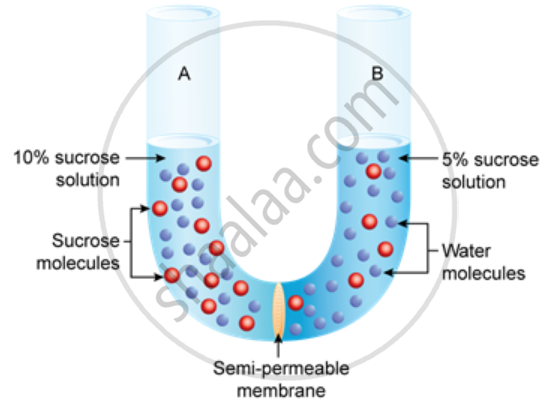
What is meant by 'semipermeable membrane'?
The figure given below is a diagrammatic representation of a part of the cross-section of the root in the root hair zone. Study the same and then answer the questions that follow :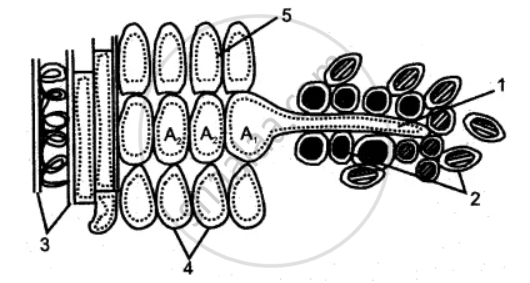
(i) Name the parts indicated by guidelines ‘1’ to ‘5’
(ii) Is the root hair cell unicellular or multi-cellular?
(iii) Draw a labeled diagram of the root hair cell as it would appear if some fertilizer is added to the soil close to it.
(iv) Name the process responsible for the entry of water molecules from the soil into A1 and then A2.
(v) What pressure is responsible for the movement of water in the direction indicated by arrows?
(vi) How is this pressure set up?
How many regions are there in a typical root?
Root hair occurs in the zone of ____________.
Water in the root enters due to ______.
