Advertisements
Advertisements
Question
What is Active transport?
Advertisements
Solution
Active transport is the passage of a substance (salt or ion) from its lower to higher concentration through a living cell membrane using energy from the cell. Active transport is in a direction opposite to that of diffusion. Certain nutrients, such as ions of nitrates, sulphates, potassium, zinc, manganese, etc., cannot pass through the cell membrane of the root cells easily. This is because their concentration is higher inside the root cells, and it is so maintained in order to develop osmotic pressure for absorbing water.
RELATED QUESTIONS
State the main function of the Guard cells
Fill in the blank with the suitable term given below:
The upward movement of sap that contains water and minerals is called _______ of sap.
Fill in the blank with the suitable term given below:
The leaves have more__________ on their lower surface.
Active transport is one in which the ions outside the roots are ___________.
Active transport involves ______
Which of the following process requires energy?
Explain the term Active transport.
Active transport is one in which the ions outside the roots move in by utilising ______.
Define the following term:
Active transport
Three cylinders of potato were carefully dried on blotting paper and weighed. Each piece weighed 3 grams. Each one was placed in the beaker as shown below:
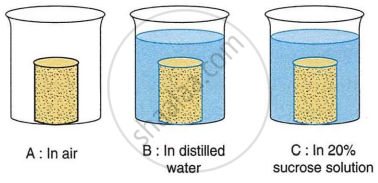
Answer the following questions:
- After 48 hours, which potato cylinder would be the heaviest?
- The movement of which substance is mainly responsible for the weight change in the potato cylinders?
- Name and define the process which is responsible for the movement of the substance mentioned in answer (b).
- Write specific names of the processes which occur in beakers B and C. [kinds of processes defined in answer (c)].
- Would there be any difference in the weight of the potato cylinder in beaker A after 48 hours? Give reason.
